Elasmobranquios (tiburones y rayas) (sharks and rays) >
Carcharhiniformes (Ground sharks) >
Triakidae (Houndsharks) > Triakinae
Etymology: Mustelus: Latin for weasel, an ancient name for sharks, possibly referring to the pointed snouts, swift movements and/or rapacious feeding behavior of smaller predatory sharks [strictly not tautonymous with Squalus mustelus Linnaeus 1758 since type was designated by the ICZN] (See ETYFish); albipinnis: albus (L.), white; pinnis (L.), fins, referring to white margin around dorsal, pectoral, pelvic and anal fins (See ETYFish).
Entorno: milieu / zona climática / rango de profundidad / gama de distribución
Ecología
marino bentopelágico; rango de profundidad 30 - 281 m (Ref. 30948). Tropical
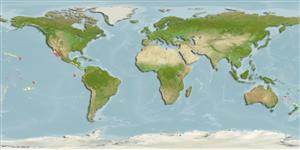
Eastern Pacific: Gulf of California.
Tamaño / Peso / Edad
Madurez: Lm ? range ? - ? cm
Max length : 109 cm TL macho / no sexado; (Ref. 30948); 118.0 cm TL (female)
Descripción breve
Claves de identificación | Morfología | Morfometría
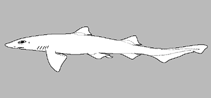
Description of Mustelus hacat: this species differs from its congeners in having a uniformly dark gray brown color above and conspicuously having white tips and trailing edges of the dorsal, pectoral, anal, and caudal fins. Although some specimens of M. lunulatus and newborn pups and juveniles of M. canis from the western Atlantic, have tips and trailing edges of first dorsal, pectoral, anal, and caudal fins transparent or pale white, they clearly differ from this species in having less contrasted dorsal color compared with tips and trailing edges of the fins. Mustelus hacat is distinguished from the other eastern North Pacific species of Mustelus in having: 1) upper jaw teeth cuspidate and distinctly asymmetric, with low rounded cusp (teeth of californicus and lunulatus are from molariform to cuspidate and slightly asymmetric, with blunt to low rounded cusp, whereas henlei
and dorsalis have cuspidate and slightly asymmetric, with high sharp cusp teeth); 2) upper jaw labial folds notably longer than the lower folds, only similar to henlei (californicus has upper and lower jaw labial folds about equal in length, lunulatus has upper jaw labial folds notably shorter than lower jaw labial folds, and dorsalis has upper jaw labial folds slightly longer than lower jaw labial folds); 3) posterior margin of first dorsal fin vertical from apex, only similar to lunulatus, californicus, henlei, and dorsalis have the first dorsal fin with sloping posterior margin); 4) inter-nostril space wide (49-58 vs. 33-49% pre-oral length for all other four species); and 5) inter-orbital space wide (5.6-6.8 vs. 4.3-5.6% TL for californicus, henlei, lunulatus, but similar to dorsalis 5.7-7.5% TL) (Ref. 30948).
Body shape (shape guide): elongated.
Information for Mustelus hacat include mode of reproduction is placental viviparity, having a brood size of 3 to 23 (mean 16); embryo measures 25-34 cm TL (mean 29 cm); young born probably between 30-35 cm TL; females mature between 94-98 cm and males between 90-99 cm TL. Caught by trawlers (Ref. 30948).
Ciclo vital y comportamiento de apareamiento
Madurez | Reproducción | Puesta | Huevos | Fecundidad | Larva
Castro-Aguirre, J.L., A. Antuna-Mendiola, A.F. González-Acosta and J. De la Cruz-Agüero, 2005. Mustelus albipinnis sp. Nov. (Chondrichthyes: Carcharhiniformes: Triakidae) from the southwestern coast of Baja California Sur, México. Hidrobiológica 15(2):123-130. (Ref. 91262)
Situación en la Lista Roja de la UICN (Ref. 130435: Version 2025-2 (Global))
Amenaza para el ser humano
Harmless
Usos humanos
Pesquerías: bycatch
Herramientas
Informes especiales
Descargar XML
Fuentes de Internet
Estimaciones basadas en modelos
Temperatura preferida (Referencia
123201): 12.6 - 20.1, mean 15.3 °C (based on 41 cells).
Índice de diversidad filogenética (Referencia
82804): PD
50 = 0.5000 [Uniqueness, from 0.5 = low to 2.0 = high].
Bayesian length-weight: a=0.00229 (0.00107 - 0.00491), b=3.14 (2.97 - 3.31), in cm total length, based on LWR estimates for this Genus-body shape (Ref.
93245).
Nivel trófico (Referencia
69278): 3.6 ±0.4 se; based on size and trophs of closest relatives
Resiliencia (Referencia
120179): Medio, población duplicada en un tiempo mínimo de 1.4-4.4 años (Preliminary K or Fecundity.).
Vulnerabilidad pesquera (Ref.
59153): High to very high vulnerability (71 of 100).
🛈
Nutrientes (Ref.
124155): Calcium = 19.9 [5.8, 106.3] mg/100g; Iron = 0.373 [0.105, 1.367] mg/100g; Protein = 20.3 [18.0, 22.7] %; Omega3 = 0.0904 [, ] g/100g; Selenium = 96.1 [27.3, 382.5] μg/100g; VitaminA = 18.1 [5.9, 54.2] μg/100g; Zinc = 0.985 [0.423, 2.081] mg/100g (wet weight);