分類 / 名稱
俗名 | 同種異名 | Catalog of Fishes(屬, 種) | ITIS | CoL | WoRMS | Cloffa
Elasmobranchii
板鰓亞綱 (鯊魚與魟魚) (sharks and rays) >
Carcharhiniformes (Ground sharks)
真鯊目 (Ground sharks) >
Triakidae (Houndsharks)
平滑鮫 (Houndsharks) > Triakinae
Etymology: Mustelus: Latin for weasel, an ancient name for sharks, possibly referring to the pointed snouts, swift movements and/or rapacious feeding behavior of smaller predatory sharks [strictly not tautonymous with Squalus mustelus Linnaeus 1758 since type was designated by the ICZN] (See ETYFish); albipinnis: albus (L.), white; pinnis (L.), fins, referring to white margin around dorsal, pectoral, pelvic and anal fins (See ETYFish).
環境: 環境 / 氣候帶 / 深度上下限 / 配送範圍
生態學
海洋 底中水層性; 深度上下限 30 - 281 m (Ref. 30948).
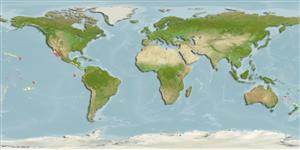
Eastern Pacific: Gulf of California.
大小 / 重量 / 年齡
成熟度: Lm ? range ? - ? cm
Max length : 109 cm TL 雄魚/尚未辨別雌雄; (Ref. 30948); 118.0 cm TL (female)
簡短描述
檢索表 | 型態特徵 | 形態測量圖
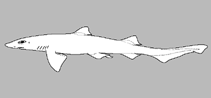
Description of Mustelus hacat: this species differs from its congeners in having a uniformly dark gray brown color above and conspicuously having white tips and trailing edges of the dorsal, pectoral, anal, and caudal fins. Although some specimens of M. lunulatus and newborn pups and juveniles of M. canis from the western Atlantic, have tips and trailing edges of first dorsal, pectoral, anal, and caudal fins transparent or pale white, they clearly differ from this species in having less contrasted dorsal color compared with tips and trailing edges of the fins. Mustelus hacat is distinguished from the other eastern North Pacific species of Mustelus in having: 1) upper jaw teeth cuspidate and distinctly asymmetric, with low rounded cusp (teeth of californicus and lunulatus are from molariform to cuspidate and slightly asymmetric, with blunt to low rounded cusp, whereas henlei
and dorsalis have cuspidate and slightly asymmetric, with high sharp cusp teeth); 2) upper jaw labial folds notably longer than the lower folds, only similar to henlei (californicus has upper and lower jaw labial folds about equal in length, lunulatus has upper jaw labial folds notably shorter than lower jaw labial folds, and dorsalis has upper jaw labial folds slightly longer than lower jaw labial folds); 3) posterior margin of first dorsal fin vertical from apex, only similar to lunulatus, californicus, henlei, and dorsalis have the first dorsal fin with sloping posterior margin); 4) inter-nostril space wide (49-58 vs. 33-49% pre-oral length for all other four species); and 5) inter-orbital space wide (5.6-6.8 vs. 4.3-5.6% TL for californicus, henlei, lunulatus, but similar to dorsalis 5.7-7.5% TL) (Ref. 30948).
Body shape (shape guide): elongated.
Information for Mustelus hacat include mode of reproduction is placental viviparity, having a brood size of 3 to 23 (mean 16); embryo measures 25-34 cm TL (mean 29 cm); young born probably between 30-35 cm TL; females mature between 94-98 cm and males between 90-99 cm TL. Caught by trawlers (Ref. 30948).
生命週期和交配行為
成熟度 | 繁殖 | 產卵場 | 卵 | 孕卵數 | 仔魚
Castro-Aguirre, J.L., A. Antuna-Mendiola, A.F. González-Acosta and J. De la Cruz-Agüero, 2005. Mustelus albipinnis sp. Nov. (Chondrichthyes: Carcharhiniformes: Triakidae) from the southwestern coast of Baja California Sur, México. Hidrobiológica 15(2):123-130. (Ref. 91262)
IUCN 瀕危狀態 (Ref. 130435: Version 2025-2 (Global))
無危 (LC) ; Date assessed: 06 February 2019
人類使用
漁業: bycatch
工具
特別的報告
下載 XML
網路資源
基於模型的估計
首選溫度 (參考文獻
123201): 12.6 - 20.1, mean 15.3 °C (based on 41 cells).
系統發育多樣性指數 (參考文獻
82804): PD
50 = 0.5000 [Uniqueness, from 0.5 = low to 2.0 = high].
Bayesian length-weight: a=0.00229 (0.00107 - 0.00491), b=3.14 (2.97 - 3.31), in cm total length, based on LWR estimates for this Genus-body shape (Ref.
93245).
營養階層 (參考文獻
69278): 3.6 ±0.4 se; based on size and trophs of closest relatives
回復力 (參考文獻
120179): 中等的, 族群倍增時間最少 1.4 - 4.4年 (Preliminary K or Fecundity.).
釣魚的脆弱性 (Ref.
59153): High to very high vulnerability (71 of 100).
🛈
營養素 (Ref.
124155): Calcium = 19.9 [5.8, 106.3] mg/100g; Iron = 0.373 [0.105, 1.367] mg/100g; Protein = 20.3 [18.0, 22.7] %; Omega3 = 0.0904 [, ] g/100g; Selenium = 96.1 [27.3, 382.5] μg/100g; VitaminA = 18.1 [5.9, 54.2] μg/100g; Zinc = 0.985 [0.423, 2.081] mg/100g (wet weight);