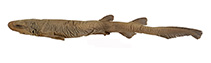
Élasmobranches (requins et raies) (sharks and rays) >
Carcharhiniformes (Ground sharks) >
Pentanchidae (Deepwater catsharks)
Etymology: Parmaturus: parma (L.), from parme (Gr.), small shield; oura (Gr.), tail, presumably referring to upper edge of caudal fin “armed with modified” scales (per Garman 1913) (See ETYFish); lanatus: Latin for “soft like wool,” referring to the velvety feel of its skin (See ETYFish).
More on authors: Séret & Last.
Environnement : milieu / zone climatique / profondeur / gamme de distribution
Écologie
marin bathydémersal; profondeur ? - 855 m (Ref. 74543). Deep-water
Western Pacific: Indonesia.
Taille / Poids / Âge
Maturité: Lm ? range ? - ? cm
Max length : 36.0 cm TL mâle / non sexé; (Ref. 74543)
This scyliorhinid catshark has the following set of characters: soft body, with velvety skin, long-cusped, tricuspidate denticles; plain brownish coloration; crests of small denticles (not enlarged) on the upper and lower caudal fin and peduncle margins; teeth are mainly quadricuspidate, about 90 rows in both jaws; first dorsal fin forward of mid-length, pre-first dorsal length 44.4% TL; pelvic fins and vent well in front of mid-length, pre-pelvic length 40.0% TL and pre-vent length 44.2% TL; relatively short snout, prenarial length 4.7% TL; relatively long mouth, its length 5.0% TL; labial furrows rudimentary; head longer than the abdomen, length 21.4% TL, pectoral-pelvic length 16.9% TL; dorsal fins are elevated, with anterior margins of first 9.2% and second 10.3% TL; subterminal caudal lobe developed, subterminal margin length 4.7% TL, terminal margin length 5.3% TL; 46 monospondylous centra; 85 precaudal centra, 134 total centra (Ref. 74543).
Body shape (shape guide): elongated.
Cycle de vie et comportement reproducteur
Maturité | Reproduction | Frai | Œufs | Fécondité | Larves
Séret, B. and P. Last, 2007. Four new species of deep-water catsharks of the genus Parmaturus (Carcharhiniformes: Scyliorhinidae) from New Caledonia, Indonesia and Australia. Zootaxa 2007:1-17. (Ref. 74543)
Statut dans la liste rouge de l'IUCN (Ref. 130435: Version 2025-2 (Global))
Menace pour l'homme
Harmless
Utilisations par l'homme
Outils
Articles particuliers
Télécharger en XML
Sources Internet
Estimations basées sur des modèles
Indice de diversité phylogénétique (Réf.
82804): PD
50 = 0.5078 [Uniqueness, from 0.5 = low to 2.0 = high].
Bayesian length-weight: a=0.00347 (0.00172 - 0.00698), b=3.08 (2.90 - 3.26), in cm total length, based on LWR estimates for this (Sub)family-body shape (Ref.
93245).
Niveau trophique (Réf.
69278): 4.0 ±0.5 se; based on size and trophs of closest relatives
Résilience (Réf.
120179): Haut, temps minimum de doublement de population inférieur à 15 mois (Preliminary K or Fecundity.).
Vulnérabilité de la pêche (Ref.
59153): Low to moderate vulnerability (26 of 100).
🛈