Classificazione / Nomi
Nomi Comuni | Sinonimi | Catalog of Fishes(Genere, Specie) | ITIS | CoL | WoRMS | Cloffa
Elasmobranchi (squali e razze) (sharks and rays) >
Carcharhiniformes (Ground sharks) >
Dichichthyidae (Bristle shark)
Etymology: Dichichthys: Name from the combination of the Greek 'dicho'- meaning 'to branch in two' and 'ichthys' for 'fish', with this genus being intermediate between the Galeus-Parmaturus complex and Apristurus; albimarginatus: albus (L.), white; marginatus (L.), bordered, referring to broad white margins on posterior fins (See ETYFish).
More on authors: Séret & Last.
Ambiente: milieu / zona climatica / distribuzione batimetrica / gamma di distribuzione
Ecologia
marino batidemersale; distribuzione batimetrica 590 - 732 m (Ref. 74543). Deep-water
Western Pacific: New Caledonia and possibly Papua New Guinea.
Dimensione / Peso / Età
Maturità: Lm ? range ? - ? cm
Max length : 57.7 cm TL maschio/sesso non determinato; (Ref. 74543)
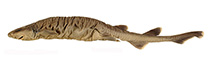
This scyliorhinid catshark is characterized by the following: a soft body with velvet-like
skin of large tricuspidate denticles; color plain pale to medium brown; posterior margins of the dorsal, caudal and anal-fins are distinctly white-edged; upper and lower anterior caudal fin margins with pronounced caudal crests, the denticles on crests are greatly enlarged; teeth are mainly tricuspidate with greatly elongate median cusps, in 92 rows in both jaws; the first dorsal fin is slightly behind middle of back, the pelvic fins slightly in front of mid-body, prepelvic
length 47% TL; vent at mid-length, pre-vent length 50% TL; relatively short snout, prenarial length 3.7% TL; short mouth, length 3.7% TL; short labial furrows, 1.7-2.0% TL, lower furrows subequal in length to upper furrows; head depressed and is shorter than abdomen, length 19.2% TL, pectoral-pelvic length 24.8% TL; second dorsal fin is larger than first, anterior margins of first 8.7% and second dorsal fin 10.4% TL; subterminal caudal lobe relatively small, subterminal margin length 3.3% TL, terminal margin length 3.8% TL; 43 monospondylous centra; 95 precaudal centra, 136 total (Ref. 74543).
Body shape (shape guide): elongated.
Ciclo vitale e comportamento di accoppiamento
Maturità | Riproduzione | Deposizione | Uova | Fecondità | Larve
White, W.T., A.L. Stewart, H.L. O’Neill and G.J.P. Naylor, 2024. Dichichthyidae, a new family of deepwater sharks (Carcharhiniformes) from the Indo–West Pacific, with description of a new species. Fishes 2024, 9, 121. (Ref. 130868)
Stato della Lista Rossa IUCN (Ref. 130435: Version 2025-2 (Global))
Minaccia per l'uomo
Harmless
Usi umani
Pesca: di nessun interesse
Strumenti
Rapporti speciali
Scarica XML
Fonti Internet
Stime basate su modelli
Indice di diversità filogenetica (Fonte Biblio.
82804): PD
50 = 0.5625 [Uniqueness, from 0.5 = low to 2.0 = high].
Bayesian length-weight: a=0.00389 (0.00180 - 0.00842), b=3.12 (2.94 - 3.30), in cm total length, based on all LWR estimates for this body shape (Ref.
93245).
Livello trofico (Fonte Biblio.
69278): 3.9 ±0.5 se; based on size and trophs of closest relatives
Vulnerabilità della pesca (Ref.
59153): Moderate vulnerability (43 of 100).
🛈