Klassifizierung / Names
Namen | Synonyme | Catalog of Fishes(Gattung, Arten) | ITIS | CoL | WoRMS | Cloffa
>
Ovalentaria/misc (Various families in series Ovalentaria) >
Pomacentridae (Damselfishes) > Chrominae
Etymology: Chromis: Greek, chromis = a fish, perhaps a perch (Ref. 45335); circumaurea: Name from Latin words 'circum' meaning round and 'aurea' for golden, of gold, for the golden-yellow coloration of its anal fin, caudal fin, and outer margin of the dorsal fin.
Umwelt: Milieu / Klimazone / Tiefenbereich / Verbreitungsgebiet
Ökologie
seewasser riff-verbunden; tiefenbereich 111 - 130 m (Ref. 128797). Tropical; 21°N - 6°N, 137°E - 164°E
Western Pacific: Yap I. (Caroline Islands, Micronesia) and probably in the Marshall and Mariana islands.
Größe / Gewicht / Alter
Geschlechtsreife: Lm ? range ? - ? cm
Max length : 10.2 cm SL Männchen/unbestimmt; (Ref. 59379)
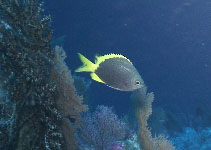
Rückenflossenstacheln (insgesamt) : 14; Rückenflossenweichstrahlen (insgesamt) : 12 - 13; Afterflossenstacheln: 2; Afterflossenweichstrahlen: 13 - 14. This species is distinguished by the following characters: Dorsal rays XIV,12-13, usually 13; anal rays II, 13-14, usually 13; pectoral rays 18-19; spiniform caudal rays 3; tubed lateral-line scales 16-17; gill rakers 6-7 + 20-21, total 26-27; body depth 1.68-1.86 in SL. The color when fresh is mahogany brown with bright yellow distally on spinous portion of dorsal fin; the soft portion of dorsal fin, caudal fin, and anal fin is bright yellow.
Body shape (shape guide): short and / or deep.
This species was observed at Yap (Caroline Islands), in a group of about a dozen individuals living among large (about 1-2 m) rock boulders just above the upper edge of a precipitous drop-off. A juvenile of approximately 4 cm SL was observed at a depth of 120 m, below the site where the type specimens were collected. Its color pattern was consistent with that of the adults (Ref. 59379). Life history characteristics for the family specify that this group is oviparous, with distinct pairing during breeding (Ref. 205). Eggs are demersal and adhere to the substrate (Ref. 205). Males guard and aerate the eggs (Ref. 205).
Lebenszyklus und Paarungsverhalten
Geschlechtsreife | Fortpflanzung | Ablaichen | Eier | Fruchtbarkeit | Larven
Oviparous, distinct pairing during breeding (Ref. 205). Eggs are demersal and adhere to the substrate (Ref. 205). Males guard and aerate the eggs (Ref. 205).
Pyle, R., J.L. Earle and B.D. Greene, 2008. Five new species of the damselfish genus Chromis (Perciformes: Labroidei: Pomacentridae) from deep coral reefs in the tropical western Pacific. Zootaxa 1671:3-31. (Ref. 59379)
IUCN Rote Liste Status (Ref. 130435: Version 2025-2 (Global))
Bedrohung für Menschen
Harmless
Nutzung durch Menschen
Fischereien: nicht kommerziell
Tools
Zusatzinformationen
Download XML
Internet Quellen
Schätzungen auf der Grundlage von Modellen
Phylogenetischer Diversitätsindex (Ref.
82804): PD
50 = 0.5000 [Uniqueness, from 0.5 = low to 2.0 = high].
Bayesian length-weight: a=0.01778 (0.00800 - 0.03953), b=3.00 (2.82 - 3.18), in cm total length, based on LWR estimates for this Genus-body shape (Ref.
93245).
Trophische Ebene (Ref.
69278): 3.0 ±0.1 se; based on size and trophs of closest relatives
Widerstandsfähigkeit (Ref.
120179): hoch, Verdopplung der Population dauert weniger als 15 Monate. (Preliminary K or Fecundity.).
Anfälligkeit der Fischerei (Ref.
59153): Low vulnerability (10 of 100).
🛈