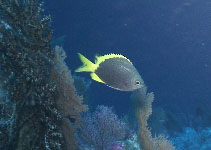
>
Ovalentaria/misc (Various families in series Ovalentaria) >
Pomacentridae (Damselfishes) > Chrominae
Etymology: Chromis: Greek, chromis = a fish, perhaps a perch (Ref. 45335); circumaurea: Name from Latin words 'circum' meaning round and 'aurea' for golden, of gold, for the golden-yellow coloration of its anal fin, caudal fin, and outer margin of the dorsal fin.
Lingkungan: lingkungan / zona iklim / kisaran kedalaman / jangkauan distribusi
Ekologi
laut berasosiasi dengan karang; kisaran kedalaman 111 - 130 m (Ref. 128797). Tropical; 21°N - 6°N, 137°E - 164°E
Western Pacific: Yap I. (Caroline Islands, Micronesia) and probably in the Marshall and Mariana islands.
Ukuran / Berat / umur
Kematangan: Lm ? range ? - ? cm
Max length : 10.2 cm SL jantan/; (Ref. 59379)
deskripsi pendek
Kunci identifiaksi (pengenalan) | Morfologi | Morfometrik
Duri punggung (Keseluruhan (total)) : 14; duri punggung lunak (Keseluruhan (total)) : 12 - 13; Duri dubur: 2; Sirip dubur lunak: 13 - 14. This species is distinguished by the following characters: Dorsal rays XIV,12-13, usually 13; anal rays II, 13-14, usually 13; pectoral rays 18-19; spiniform caudal rays 3; tubed lateral-line scales 16-17; gill rakers 6-7 + 20-21, total 26-27; body depth 1.68-1.86 in SL. The color when fresh is mahogany brown with bright yellow distally on spinous portion of dorsal fin; the soft portion of dorsal fin, caudal fin, and anal fin is bright yellow.
Body shape (shape guide): short and / or deep.
This species was observed at Yap (Caroline Islands), in a group of about a dozen individuals living among large (about 1-2 m) rock boulders just above the upper edge of a precipitous drop-off. A juvenile of approximately 4 cm SL was observed at a depth of 120 m, below the site where the type specimens were collected. Its color pattern was consistent with that of the adults (Ref. 59379). Life history characteristics for the family specify that this group is oviparous, with distinct pairing during breeding (Ref. 205). Eggs are demersal and adhere to the substrate (Ref. 205). Males guard and aerate the eggs (Ref. 205).
Siklus hidup dan perilaku kawin
Kematangan | Reproduksi, perkembang biakan | Pemijahan | telur-telur | Fekunditas | Larva
Oviparous, distinct pairing during breeding (Ref. 205). Eggs are demersal and adhere to the substrate (Ref. 205). Males guard and aerate the eggs (Ref. 205).
Pyle, R., J.L. Earle and B.D. Greene, 2008. Five new species of the damselfish genus Chromis (Perciformes: Labroidei: Pomacentridae) from deep coral reefs in the tropical western Pacific. Zootaxa 1671:3-31. (Ref. 59379)
Status IUCN Red List (Ref. 130435: Version 2025-2 (Global))
ancaman kepada manusia
Harmless
penggunaan manusia
Perikanan: tidak ada kepentingan
Alat, peralatan
laporan khas
muat turun XML
Sumber internet
Estimasi berdasarkan model
Indeks keanekaragaman filogenetik (Acuan
82804): PD
50 = 0.5000 [Uniqueness, from 0.5 = low to 2.0 = high].
Bayesian length-weight: a=0.01778 (0.00800 - 0.03953), b=3.00 (2.82 - 3.18), in cm total length, based on LWR estimates for this Genus-body shape (Ref.
93245).
Tingkat Trofik (Acuan
69278): 3.0 ±0.1 se; based on size and trophs of closest relatives
Daya lenting (Acuan
120179): Tinggi, Waktu penggandaan populasi minimum kurang dari 15 bulan (Preliminary K or Fecundity.).
Kerentanan Penangkapan Ikan (Ref.
59153): Low vulnerability (10 of 100).
🛈