>
Gobiiformes (Gobies) >
Gobiidae (Gobies) > Gobiinae
Etymology: Trimma: Greek, trimma, -atos = something crushed (Ref. 45335); flavatrum: Name from Latin 'flavus' meaning yellow and 'atrum' for black, referring to the unusual yellow and black coloration of the new species.
More on authors: Hagiwara & Winterbottom.
Environnement : milieu / zone climatique / profondeur / gamme de distribution
Écologie
marin benthopélagique; profondeur 10 - 30 m (Ref. 90102). Subtropical
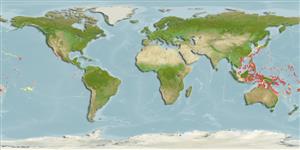
Western Pacific. Japan to Australia.
Taille / Poids / Âge
Maturité: Lm ? range ? - ? cm
Max length : 2.3 cm SL mâle / non sexé; (Ref. 58123)
Description synthétique
Clés d'identification | Morphologie | Morphométrie
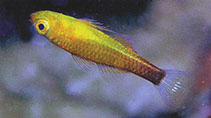
Épines dorsales (Total) : 7; Rayons mous dorsaux (Total) : 7 - 8; Épines anales: 1; Rayons mous anaux: 7 - 8. This species is characterized by the following: presence of scales in the predorsal midline and on the cheek and opercle; no elongate dorsal spines; a broad and somewhat concave interorbital region with a bony interorbital equal to about half or more of the width of the pupil with no raised, longitudinal, fleshy ridge in the midline; no postorbital trench; fifth pelvic fin ray usually unbranched (may be branched once sequentially); preserved specimens with a dusky body with densely scattered melanophores and chromatophores, the shade intensifying posteriorly to almost black in the peduncular region; body of alive or freshly collected specimens have yellow to dirty yellow-orange with scattered melanophores intensifying to a blackish or dark brown caudal peduncle, with median fins reddish-orange to yellow with a dark basal stripe, except for the caudal fin, which varies from almost translucent to yellow with whitish margins (Ref. 58123); characterized further by having longitudinal scale series 22-26; predorsal scales 7-8; depth of body about 4.4-4.6 in SL (Ref. 90102).
Body shape (shape guide): fusiform / normal; Cross section: compressed.
This species forms small schools which are sometimes mixed with T. tevegae. The fishes hover in caves, recesses or under the overhangs of coral reefs. When hovering, the ventral side faces the nearest substrate surface (e.g. the wall or roof of a cave) the same as with T. tevegae. However, T. flavatrum tends to be found more towards the back of the caves and recesses (Ref. 58123).
Cycle de vie et comportement reproducteur
Maturité | Reproduction | Frai | Œufs | Fécondité | Larves
Hagiwara, K. and R. Winterbottom, 2007. Two new species of Trimma (Gobiidae) from the Western Pacific. Bull. Natl. Mus. Nat. Sci., Ser. A, Suppl. 1:163-174. (Ref. 58123)
Statut dans la liste rouge de l'IUCN (Ref. 130435: Version 2025-2 (Global))
Menace pour l'homme
Harmless
Utilisations par l'homme
Pêcheries: sans intérêt
Outils
Articles particuliers
Télécharger en XML
Sources Internet
Estimations basées sur des modèles
Température préférée (Réf.
123201): 24.9 - 28.8, mean 27.7 °C (based on 160 cells).
Indice de diversité phylogénétique (Réf.
82804): PD
50 = 0.5000 [Uniqueness, from 0.5 = low to 2.0 = high].
Bayesian length-weight: a=0.01023 (0.00477 - 0.02194), b=3.01 (2.83 - 3.19), in cm total length, based on LWR estimates for this (Sub)family-body shape (Ref.
93245).
Résilience (Réf.
120179): Haut, temps minimum de doublement de population inférieur à 15 mois (Preliminary K or Fecundity.).
Vulnérabilité de la pêche (Ref.
59153): Low vulnerability (10 of 100).
🛈