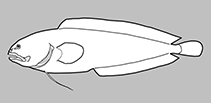
>
Ophidiiformes (Cusk eels) >
Dinematichthyidae (Viviparous brotula)
Etymology: Ogilbichthys: Named for the great Australian ichthyologist, J. Douglas Ogilby; haitiensis: Named for its type locality, Haiti.
Eponymy: James Douglas Ogilby (1853–1925) was an Irish-born Australian ichthyologist and taxonomist, son of the famous zoologist William Ogilby (below). [...] (Ref. 128868), visit book page.
More on authors: Møller, Schwarzhans & Nielsen.
Entorno: milieu / zona climática / rango de profundidad / gama de distribución
Ecología
marino bentopelágico; rango de profundidad 1 - 5 m (Ref. 55786). Tropical
Western Central Atlantic: Haiti.
Tamaño / Peso / Edad
Madurez: Lm ? range ? - ? cm
Max length : 2.2 cm SL macho / no sexado; (Ref. 55786)
Descripción breve
Claves de identificación | Morfología | Morfometría
Radios blandos dorsales (total) : 61; Radios blandos anales: 47 - 48; Vértebra: 36 - 37. This species is characterized by the following: dorsal fin rays 61, anal fin rays 47-48; no scales on head; dentary with 3-4 large fangs in mid section; anterior inner pseudoclasper ridge-like, backward-directed, smaller than posterior inner pseudoclasper, the latter with little thorn anteriorly and connected to isthmus; outer pseudoclasper triangular (Ref. 55786).
Ciclo vital y comportamiento de apareamiento
Madurez | Reproducción | Puesta | Huevos | Fecundidad | Larva
Møller, P.R., W. Schwarzhans and J.G. Nielsen, 2004. Review of the American Dinematichthyini (Teleostei, Bythitidae). Part I. Dinematichthys, Gunterichthys, Typhliasina and two new genera. aqua, J. Ichthyol. Aquat. Biol. 8(4):141-192. (Ref. 55786)
Situación en la Lista Roja de la UICN (Ref. 130435: Version 2025-2 (Global))
Amenaza para el ser humano
Harmless
Usos humanos
Herramientas
Informes especiales
Descargar XML
Fuentes de Internet
Estimaciones basadas en modelos
Índice de diversidad filogenética (Referencia
82804): PD
50 = 0.5078 [Uniqueness, from 0.5 = low to 2.0 = high].
Bayesian length-weight: a=0.00389 (0.00180 - 0.00842), b=3.12 (2.94 - 3.30), in cm total length, based on all LWR estimates for this body shape (Ref.
93245).
Nivel trófico (Referencia
69278): 3.1 ±0.5 se; based on size and trophs of closest relatives
Vulnerabilidad pesquera (Ref.
59153): Low vulnerability (10 of 100).
🛈