>
Ophidiiformes (Cusk eels) >
Dinematichthyidae (Viviparous brotula)
Etymology: Ogilbichthys: Named for the great Australian ichthyologist, J. Douglas Ogilby; haitiensis: Named for its type locality, Haiti.
Eponymy: James Douglas Ogilby (1853–1925) was an Irish-born Australian ichthyologist and taxonomist, son of the famous zoologist William Ogilby (below). [...] (Ref. 128868), visit book page.
More on authors: Møller, Schwarzhans & Nielsen.
Ambiente: milieu / zona climatica / distribuzione batimetrica / gamma di distribuzione
Ecologia
marino benthopelagico; distribuzione batimetrica 1 - 5 m (Ref. 55786). Tropical
Western Central Atlantic: Haiti.
Dimensione / Peso / Età
Maturità: Lm ? range ? - ? cm
Max length : 2.2 cm SL maschio/sesso non determinato; (Ref. 55786)
Breve descrizione
Chiavi di identificazione | Morfologia | Morfometria
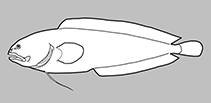
Raggi dorsali molli (totale) : 61; Raggi anali molli: 47 - 48; Vertebre: 36 - 37. This species is characterized by the following: dorsal fin rays 61, anal fin rays 47-48; no scales on head; dentary with 3-4 large fangs in mid section; anterior inner pseudoclasper ridge-like, backward-directed, smaller than posterior inner pseudoclasper, the latter with little thorn anteriorly and connected to isthmus; outer pseudoclasper triangular (Ref. 55786).
Ciclo vitale e comportamento di accoppiamento
Maturità | Riproduzione | Deposizione | Uova | Fecondità | Larve
Møller, P.R., W. Schwarzhans and J.G. Nielsen, 2004. Review of the American Dinematichthyini (Teleostei, Bythitidae). Part I. Dinematichthys, Gunterichthys, Typhliasina and two new genera. aqua, J. Ichthyol. Aquat. Biol. 8(4):141-192. (Ref. 55786)
Stato della Lista Rossa IUCN (Ref. 130435: Version 2025-2 (Global))
Minaccia per l'uomo
Harmless
Usi umani
Strumenti
Rapporti speciali
Scarica XML
Fonti Internet
Stime basate su modelli
Indice di diversità filogenetica (Fonte Biblio.
82804): PD
50 = 0.5078 [Uniqueness, from 0.5 = low to 2.0 = high].
Bayesian length-weight: a=0.00389 (0.00180 - 0.00842), b=3.12 (2.94 - 3.30), in cm total length, based on all LWR estimates for this body shape (Ref.
93245).
Livello trofico (Fonte Biblio.
69278): 3.1 ±0.5 se; based on size and trophs of closest relatives
Vulnerabilità della pesca (Ref.
59153): Low vulnerability (10 of 100).
🛈