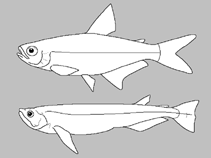
分类 / 名称
俗名 | 同种异名 | Catalog of Fishes(属, 种) | ITIS | CoL | WoRMS | Cloffa
Teleostei >
Characiformes (Characins) >
Characidae (Characins; tetras) > Cheirodontinae
Etymology: Odontostilbe: Greek, odous = teeth + Greek, stilbe, es = lamp (Ref. 45335); ecuadorensis: The epithet ecuadorensis refers to the country
where the species was first discovered.
环境:氛围 / 气候带 / 深度上下限 / 分布范围
生态学
; 淡水 大洋性. 热带
分布
领土 | FAO区域 | 生态系 | 标本纪录 | 分布图 | 简介 | Faunafri
South America: Ecuador and Peru on border with Ecuador. Río Napo, río Putumayo, and río Pastaza basins. The species is also recorded on lower río Napo basin in sympatry with O. fugitiva.
南美洲: 与厄瓜多的厄瓜多 , 与在边缘上的秘鲁。 Rio Napo , rio Putumayo 与 rio Pastaza 流域。 此鱼种也在 sympatry 中的低 rio Napo 流域上被 O. fugitiva 记录。
大小 / 重量 / 年龄
成熟度: Lm ? range ? - ? cm
Max length : 4.6 cm SL 雄鱼/尚未辨别雌雄; (Ref. 57085); 5.0 cm SL (female)
简单描述
检索表 | 型态特徵 | 形态测量图
Characters that diagnose Odontostilbe ecuadorensis are: (1) upper gill rakers 5-6, lower 9-11, mostly 10-11 (vs. upper gill rakers 6-8, mostly 6-7, and lower 11-14, usually 12 in
O. fugitiva; (2) denticulation of gill rakers more numerous in O. ecuadorensis than in O. fugitiva (in specimens
larger than 32.5 mm SL), mainly on posteriormost gill raker of lower arch (5-6 denticles on basal portions of gill raker in O. ecuadorensis vs. 0-2 in O. fugitiva; (3) elongate 2nd unbranched dorsal-fin ray (vs. not elongate in O. euspilura and very short elongate in O. pulchra); (4) no hooks on unbranched pelvic-fin ray (vs. 1-2 unpaired hooks per segment on 1st unbranched pelvic-fin ray occasionally present in O. euspilura and O. pulchra); (5) 1-3 paired or unpaired hooks per segment on last unbranched anal-fin ray, and 1st to 16th anal-fin branched rays (small hooks like knots on anal-fin ray branches, usually on 10th branched fin ray and following rays) (vs. well-developed hooks on 1st to 22nd anal-fin branched rays at distal half length of fin rays in O. pulchra); and (6) usually seven large dentary teeth, with seven cusps (vs. 4 large dentary teeth with 3 large and compressed central cusps and 2, 3 lateral small cusps in O. pequira). Odontostilbe ecuadorensis differs from sympatric O. euspilura by its terminal mouth (vs. subterminal mouth).
Body shape (shape guide): elongated.
鉴定的特征 Odontostilbe ecuadorensis 是: (1) 上面的鳃耙 5-6, 低的 9-11, 大部份 10-11(vs. 上面的鳃耙 6-8, 大部份 6-7, 与低的 11-14, 通常 12 在
O. fugitiva; (2) 鳃耙的小齿状突起众多的在 O. ecuadorensis 中超过在 O. fugitiva 中 (在标本中
大于 32.5 mm SL), 主要吃低弓的最后面鳃耙 (在 O.fugitiva 中的 O. ecuadorensis 和 0-2 比較中的鰓耙的基部部分上的 5-6 細齒; (3) 延長第二個不分枝的背鰭鰭條;(vs. 不是細長在 O. pulchra 中的 O. euspilura 與非常短的延長) (4) 沒有在不分枝的腹鰭鰭條上的鉤;(vs.1-2 在第一上的不成對的每片段鉤不分枝的腹鰭鰭條偶然地出現在 O. euspilura 與 O. pulchra) (5) 在最後的不分枝的臀鰭鰭條上的 1-3個成對或不成對的每片段鉤 , 與第 16個臀鰭分支條 (小的鉤在臀鰭鰭條分支上類似節, 通常在第 10個分枝鰭鰭條上與跟隨鰭條) 的第一;(vs. 對在鰭條的末梢部一半長度在 O. pulchra 的第 22個臀鰭分支條的在第一上的發展良好的鉤) 而且 (6) 通常七個大的齒骨齒, 有七個尖頭.(vs.4個大的齒骨在 O. pequira 中牙齒有 3個大而扁長形的中央尖頭與 2, 3個側部小的尖頭) Odontostilbe ecuadorensis 用它的端位口有別於分佈區重疊的 O. euspilura 。 (vs. 接近端位的嘴)
生命周期和交配行为
成熟度 | 繁殖 | 产卵场 | 卵 | 孕卵数 | 仔鱼
南美洲: 与厄瓜多的厄瓜多 , 与在边缘上的秘鲁。 Rio Napo , rio Putumayo 与 rio Pastaza 流域。 此鱼种也在 sympatry 中的低 rio Napo 流域上被 O. fugitiva 记录。
Bührnheim, C.M. and L.R. Malabarba, 2006. Redescription of the type species of Odontostilbe Cope, 1870 (Teleostei: Characidae: Cheirodontinae), and description of three new species from the Amazon basin. Neotrop. Ichthyol. 4(2):167-196. (Ref. 57085)
世界自然保护联盟红皮书 (Ref. 130435: Version 2025-2 (Global))
人类利用
工具
特别资料
下载 XML
网络资源
基于模型的估算
系统发育多样性指数 (参考文献
82804): PD
50 = 0.5000 [Uniqueness, from 0.5 = low to 2.0 = high].
Bayesian length-weight: a=0.00912 (0.00403 - 0.02064), b=3.06 (2.87 - 3.25), in cm total length, based on LWR estimates for this (Sub)family-body shape (Ref.
93245).
营养阶层 (参考文献
69278): 2.4 ±0.5 se; based on size and trophs of closest relatives
渔业脆弱性 (Ref.
59153): Low vulnerability (10 of 100).
🛈