分類 / 名稱
俗名 | 同種異名 | Catalog of Fishes(屬, 種) | ITIS | CoL | WoRMS | Cloffa
Teleostei >
Characiformes (Characins)
脂鯉目 (Characins) >
Characidae (Characins; tetras)
脂鯉科 (Characins; tetras) > Cheirodontinae
Etymology: Odontostilbe: Greek, odous = teeth + Greek, stilbe, es = lamp (Ref. 45335); ecuadorensis: The epithet ecuadorensis refers to the country
where the species was first discovered.
環境: 環境 / 氣候帶 / 深度上下限 / 配送範圍
生態學
; 淡水 大洋性. 熱帶
分布
領土 | FAO區域 | 生態系 | 發現紀錄 | 分布圖 | 簡介 | Faunafri
South America: Ecuador and Peru on border with Ecuador. Río Napo, río Putumayo, and río Pastaza basins. The species is also recorded on lower río Napo basin in sympatry with O. fugitiva.
南美洲: 與厄瓜多的在邊緣上的厄瓜多與祕魯。 Rio Napo , rio Putumayo 與 rio Pastaza 流域。 此魚種也在 sympatry 中的低 rio Napo 流域上被 O. fugitiva 記錄。
大小 / 重量 / 年齡
成熟度: Lm ? range ? - ? cm
Max length : 4.6 cm SL 雄魚/尚未辨別雌雄; (Ref. 57085); 5.0 cm SL (female)
簡短描述
檢索表 | 型態特徵 | 形態測量圖
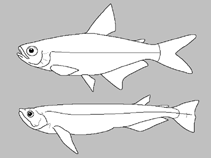
Characters that diagnose Odontostilbe ecuadorensis are: (1) upper gill rakers 5-6, lower 9-11, mostly 10-11 (vs. upper gill rakers 6-8, mostly 6-7, and lower 11-14, usually 12 in
O. fugitiva; (2) denticulation of gill rakers more numerous in O. ecuadorensis than in O. fugitiva (in specimens
larger than 32.5 mm SL), mainly on posteriormost gill raker of lower arch (5-6 denticles on basal portions of gill raker in O. ecuadorensis vs. 0-2 in O. fugitiva; (3) elongate 2nd unbranched dorsal-fin ray (vs. not elongate in O. euspilura and very short elongate in O. pulchra); (4) no hooks on unbranched pelvic-fin ray (vs. 1-2 unpaired hooks per segment on 1st unbranched pelvic-fin ray occasionally present in O. euspilura and O. pulchra); (5) 1-3 paired or unpaired hooks per segment on last unbranched anal-fin ray, and 1st to 16th anal-fin branched rays (small hooks like knots on anal-fin ray branches, usually on 10th branched fin ray and following rays) (vs. well-developed hooks on 1st to 22nd anal-fin branched rays at distal half length of fin rays in O. pulchra); and (6) usually seven large dentary teeth, with seven cusps (vs. 4 large dentary teeth with 3 large and compressed central cusps and 2, 3 lateral small cusps in O. pequira). Odontostilbe ecuadorensis differs from sympatric O. euspilura by its terminal mouth (vs. subterminal mouth).
Body shape (shape guide): elongated.
生命週期和交配行為
成熟度 | 繁殖 | 產卵場 | 卵 | 孕卵數 | 仔魚
南美洲: 與厄瓜多的在邊緣上的厄瓜多與祕魯。 Rio Napo , rio Putumayo 與 rio Pastaza 流域。 此魚種也在 sympatry 中的低 rio Napo 流域上被 O. fugitiva 記錄。
Bührnheim, C.M. and L.R. Malabarba, 2006. Redescription of the type species of Odontostilbe Cope, 1870 (Teleostei: Characidae: Cheirodontinae), and description of three new species from the Amazon basin. Neotrop. Ichthyol. 4(2):167-196. (Ref. 57085)
IUCN 瀕危狀態 (Ref. 130435: Version 2025-2 (Global))
無危 (LC) ; Date assessed: 09 October 2014
人類使用
工具
特別的報告
下載 XML
網路資源
基於模型的估計
系統發育多樣性指數 (參考文獻
82804): PD
50 = 0.5000 [Uniqueness, from 0.5 = low to 2.0 = high].
Bayesian length-weight: a=0.00912 (0.00403 - 0.02064), b=3.06 (2.87 - 3.25), in cm total length, based on LWR estimates for this (Sub)family-body shape (Ref.
93245).
營養階層 (參考文獻
69278): 2.4 ±0.5 se; based on size and trophs of closest relatives
釣魚的脆弱性 (Ref.
59153): Low vulnerability (10 of 100).
🛈