Classificazione / Nomi
Nomi Comuni | Sinonimi | Catalog of Fishes(Genere, Specie) | ITIS | CoL | WoRMS | Cloffa
>
Siluriformes (Catfishes) >
Loricariidae (Armored catfishes) > Hypostominae
Etymology: Ancistrus: Greek, agkistron = hook (Ref. 45335); verecundus: Name from Latin 'verecundus', meaning bashful, modest, in allusion to the absence or reduced development of tentacles on the snout.
Ambiente: milieu / zona climatica / distribuzione batimetrica / gamma di distribuzione
Ecologia
; acqua dolce demersale. Tropical
South America: Upper rio Madeira basin, Brazil.
Dimensione / Peso / Età
Maturità: Lm ? range ? - ? cm
Max length : 5.5 cm SL maschio/sesso non determinato; (Ref. 56914)
Breve descrizione
Chiavi di identificazione | Morfologia | Morfometria
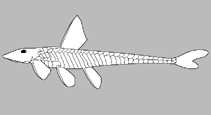
Spine dorsali (totale) : 1; Raggi dorsali molli (totale) : 7 - 8; Spine anali: 1; Raggi anali molli: 4. This species is easily distinguished from all congeners, except A. jataiensis, A. parecis, A. reisi, and A. tombador by the absence of an adipose fin which is replaced by a series of 3 to 5 median, unpaired platelets forming a low postdorsal ridge. It also differs from all congeners in lacking an adipose fin, except for A. tombador, by the naked margin of snout broad and the reduced development of snout tentacles in both sexes (usually absent), and by the presence of two or more plates of the dorsal plate series between
the end of the postdorsal ridge and the origin of the first dorsal procurrent caudal-fin (vs. one or none). This species is distinguished from A. tombador by the head depth at supraoccipital (17.9-19.3 vs. 15.6-16.9% SL), cleithral width (31.4-33.1 vs. 27.5-31.2% SL), interorbital width (15.9-16.8 vs. 12.7-15.1% SL), and by the base of the first anal-fin pterygiophore covered by skin (vs. exposed) (Ref. 56914).
Body shape (shape guide): elongated.
Facultative or obligate air-breathing (Ref. 126274)
Ciclo vitale e comportamento di accoppiamento
Maturità | Riproduzione | Deposizione | Uova | Fecondità | Larve
Fisch-Muller, S., A.R. Cardoso, J.F.P. da Silva and V.A. Bertaco, 2005. Two new Amazonian species of armored catfishes (Siluriformes: Loricariidae): Ancistrus verecundus and Ancistrus parecis. Neotrop. Ichthyol. 3(4):525-532. (Ref. 56914)
Stato della Lista Rossa IUCN (Ref. 130435: Version 2025-2 (Global))
Minaccia per l'uomo
Harmless
Usi umani
Pesca: di nessun interesse
Strumenti
Rapporti speciali
Scarica XML
Fonti Internet
Stime basate su modelli
Indice di diversità filogenetica (Fonte Biblio.
82804): PD
50 = 0.5000 [Uniqueness, from 0.5 = low to 2.0 = high].
Bayesian length-weight: a=0.01479 (0.00636 - 0.03440), b=2.98 (2.80 - 3.16), in cm total length, based on LWR estimates for this Genus-body shape (Ref.
93245).
Vulnerabilità della pesca (Ref.
59153): Low vulnerability (10 of 100).
🛈