Classification / Noms
Noms communs | Synonymes | Catalog of Fishes(Genre, Espèce) | ITIS | CoL | WoRMS | Cloffa
>
Siluriformes (Catfishes) >
Loricariidae (Armored catfishes) > Hypostominae
Etymology: Ancistrus: Greek, agkistron = hook (Ref. 45335); verecundus: Name from Latin 'verecundus', meaning bashful, modest, in allusion to the absence or reduced development of tentacles on the snout.
Environnement : milieu / zone climatique / profondeur / gamme de distribution
Écologie
; eau douce démersal. Tropical
South America: Upper rio Madeira basin, Brazil.
Taille / Poids / Âge
Maturité: Lm ? range ? - ? cm
Max length : 5.5 cm SL mâle / non sexé; (Ref. 56914)
Description synthétique
Clés d'identification | Morphologie | Morphométrie
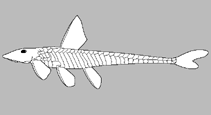
Épines dorsales (Total) : 1; Rayons mous dorsaux (Total) : 7 - 8; Épines anales: 1; Rayons mous anaux: 4. This species is easily distinguished from all congeners, except A. jataiensis, A. parecis, A. reisi, and A. tombador by the absence of an adipose fin which is replaced by a series of 3 to 5 median, unpaired platelets forming a low postdorsal ridge. It also differs from all congeners in lacking an adipose fin, except for A. tombador, by the naked margin of snout broad and the reduced development of snout tentacles in both sexes (usually absent), and by the presence of two or more plates of the dorsal plate series between
the end of the postdorsal ridge and the origin of the first dorsal procurrent caudal-fin (vs. one or none). This species is distinguished from A. tombador by the head depth at supraoccipital (17.9-19.3 vs. 15.6-16.9% SL), cleithral width (31.4-33.1 vs. 27.5-31.2% SL), interorbital width (15.9-16.8 vs. 12.7-15.1% SL), and by the base of the first anal-fin pterygiophore covered by skin (vs. exposed) (Ref. 56914).
Body shape (shape guide): elongated.
Facultative or obligate air-breathing (Ref. 126274)
Cycle de vie et comportement reproducteur
Maturité | Reproduction | Frai | Œufs | Fécondité | Larves
Fisch-Muller, S., A.R. Cardoso, J.F.P. da Silva and V.A. Bertaco, 2005. Two new Amazonian species of armored catfishes (Siluriformes: Loricariidae): Ancistrus verecundus and Ancistrus parecis. Neotrop. Ichthyol. 3(4):525-532. (Ref. 56914)
Statut dans la liste rouge de l'IUCN (Ref. 130435: Version 2025-2 (Global))
Menace pour l'homme
Harmless
Utilisations par l'homme
Pêcheries: sans intérêt
Outils
Articles particuliers
Télécharger en XML
Sources Internet
Estimations basées sur des modèles
Indice de diversité phylogénétique (Réf.
82804): PD
50 = 0.5000 [Uniqueness, from 0.5 = low to 2.0 = high].
Bayesian length-weight: a=0.01479 (0.00636 - 0.03440), b=2.98 (2.80 - 3.16), in cm total length, based on LWR estimates for this Genus-body shape (Ref.
93245).
Vulnérabilité de la pêche (Ref.
59153): Low vulnerability (10 of 100).
🛈