Klassifizierung / Names
Namen | Synonyme | Catalog of Fishes(Gattung, Arten) | ITIS | CoL | WoRMS | Cloffa
>
Beloniformes (Needle fishes) >
Adrianichthyidae (Ricefishes) > Oryziinae
Etymology: Oryzias: Greek, oryza = rice; because of the habitat used by this fish (Ref. 45335).
Umwelt: Milieu / Klimazone / Tiefenbereich / Verbreitungsgebiet
Ökologie
; süßwasser benthopelagisch; pH range: 7.5 - 8.5; standorttreu. Tropical; 22°C - 25°C (Ref. 31267)
Asia: Indonesia.
Größe / Gewicht / Alter
Geschlechtsreife: Lm ? range ? - ? cm
Max length : 5.5 cm TL Männchen/unbestimmt; (Ref. 31267); common length : 4.5 cm TL Männchen/unbestimmt; (Ref. 27139)
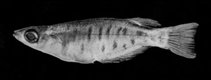
Rückenflossenweichstrahlen (insgesamt) : 8 - 9; Afterflossenweichstrahlen: 20 - 25. Distinguished from all other members of the genus by the combination of the following characters: 41-47 vertical rows of scales; 8-9 dorsal rays; 20-25 anal rays; and the distinctive color pattern of males (Ref. 26687).
Body shape (shape guide): elongated.
Non-annual breeder. Is very difficult to maintain in aquarium (Ref. 27139).
From observation in an aquarium, females carry a cluster of about 15-20 eggs which were deposited among plants and floating objects. (Ref. 26687).
Kottelat, M., A.J. Whitten, S.N. Kartikasari and S. Wirjoatmodjo, 1993. Freshwater fishes of Western Indonesia and Sulawesi. Periplus Editions, Hong Kong. 221 p. (Ref. 7050)
IUCN Rote Liste Status (Ref. 130435: Version 2025-2 (Global))
Bedrohung für Menschen
Harmless
Nutzung durch Menschen
Fischereien: kommerziell; Aquarium: Kommerziell
Tools
Zusatzinformationen
Download XML
Internet Quellen
Schätzungen auf der Grundlage von Modellen
Phylogenetischer Diversitätsindex (Ref.
82804): PD
50 = 0.5000 [Uniqueness, from 0.5 = low to 2.0 = high].
Bayesian length-weight: a=0.00479 (0.00190 - 0.01207), b=3.13 (2.91 - 3.35), in cm total length, based on LWR estimates for this (Sub)family-body shape (Ref.
93245).
Trophische Ebene (Ref.
69278): 3.5 ±0.5 se; based on size and trophs of closest relatives
Widerstandsfähigkeit (Ref.
120179): niedrig, Verdopplung der Population dauert 4,5 - 14 Jahre. (Assuming fec < 100).
Anfälligkeit der Fischerei (Ref.
59153): Low vulnerability (10 of 100).
🛈