Classificazione / Nomi
Nomi Comuni | Sinonimi | Catalog of Fishes(Genere, Specie) | ITIS | CoL | WoRMS | Cloffa
>
Siluriformes (Catfishes) >
Akysidae (Stream catfishes) > Akysinae
Etymology: Akysis: Derived from Greek, a = without + Greek, kysthos = bladder (Ref. 45335); longifilis: From the Latin longus, meaning long, and filum, meaning thread, in reference to the long barbels of this species. Used as a noun (Ref. 56465).
Ambiente: milieu / zona climatica / distribuzione batimetrica / gamma di distribuzione
Ecologia
; acqua dolce benthopelagico. Tropical
Asia: Known from the type locality in the Sittang River drainage, southern Myanmar (Ref. 56465).
Dimensione / Peso / Età
Maturità: Lm ? range ? - ? cm
Max length : 5.3 cm SL maschio/sesso non determinato; (Ref. 56465)
Breve descrizione
Chiavi di identificazione | Morfologia | Morfometria
Vertebre: 33 - 35. Akysis longifilis is a member of the A. variegatus species group and can be
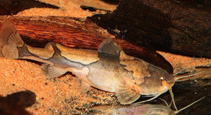
distinguished from congeners in the group (except for A. brachybarbatus, A. fuliginatus, A. pictus, A. prashadi, A. variegatus, A. varius and A. vespa) in having a smooth (vs. serrated) posterior edge of the pectoral spine. It differs from A. brachybarbatus in having a narrower head (21.1-24.7% SL vs. 25.5-28.0) and a more slender caudal peduncle (5.6-7.2% SL vs. 7.9-8.1), and from A. fuliginatus in having a longer adipose-fin base (25.7-31.1% SL vs. 15.1-19.5), more slender body (9.7-13.6% SL vs. 14.1-16.6) and caudal peduncle (5.6-7.2% SL vs. 10.1-10.5), longer nasal and maxillary barbels (nasal barbel length 67.4-96.4% HL vs. 52.1-58.2; maxillary barbel length 123.2-159.6% HL vs.100.0-109.1), presence of light saddle-shaped spots on the body (vs. uniformly dark body), and a forked (vs. truncate) caudal fin. Akysis longifilis can be distinguished from A. pictus in having a more slender caudal peduncle (5.6-7.2% SL vs. 7.7-8.5), longer
adipose-fin base (25.7-31.1% SL vs. 22.0-23.6), and longer nasal and maxillary barbels (nasal barbel length 67.4-96.4% HL vs. 54.3-56.7; maxillary barbel length 123.2-159.6% HL vs. 95.7-128.8), and from A. prashadi in having a longer caudal peduncle (18.3-23.2% SL vs. 16.5-18.4). It differs from A. variegatus in having longer nasal and maxillary barbels (nasal barbel length 67.4-96.4% HL vs. 33.3-62.3; maxillary barbel length 123.2-159.6% HL vs. 78.3-114.8), from A. varius in having a forked (vs. truncate) caudal fin, and from A. vespa in having a longer adipose-fin base (25.7-31.1% SL vs. 17.6-21.1), more slender caudal peduncle (5.6-7.2% SL vs. 7.6-8.5), longer nasal and maxillary barbels (nasal barbel length 67.4-96.4% HL vs. 54.5-72.5; maxillary barbel length 123.2-159.6% HL vs. 89.0-98.2), and more vertebrae (33-35 vs. 31-32) (Ref. 56465).
Body shape (shape guide): elongated; Cross section: compressed.
Ciclo vitale e comportamento di accoppiamento
Maturità | Riproduzione | Deposizione | Uova | Fecondità | Larve
Ng, H.H., 2006. Akysis longifilis, a new species of catfish (Teleostei: Akysidae) from Myanmar. Zootaxa 1150:19-30. (Ref. 56465)
Stato della Lista Rossa IUCN (Ref. 130435: Version 2025-2 (Global))
Minaccia per l'uomo
Harmless
Usi umani
Strumenti
Rapporti speciali
Scarica XML
Fonti Internet
Stime basate su modelli
Indice di diversità filogenetica (Fonte Biblio.
82804): PD
50 = 0.5000 [Uniqueness, from 0.5 = low to 2.0 = high].
Bayesian length-weight: a=0.00389 (0.00180 - 0.00842), b=3.12 (2.94 - 3.30), in cm total length, based on all LWR estimates for this body shape (Ref.
93245).
Livello trofico (Fonte Biblio.
69278): 3.5 ±0.6 se; based on size and trophs of closest relatives
Vulnerabilità della pesca (Ref.
59153): Low vulnerability (10 of 100).
🛈