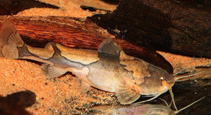
klasifikasi / Nama
Nama-nama umum | Sinonim (persamaan) | Catalog of Fishes(Marga, Jenis) | ITIS | CoL | WoRMS | Cloffa
>
Siluriformes (Catfishes) >
Akysidae (Stream catfishes) > Akysinae
Etymology: Akysis: Derived from Greek, a = without + Greek, kysthos = bladder (Ref. 45335); longifilis: From the Latin longus, meaning long, and filum, meaning thread, in reference to the long barbels of this species. Used as a noun (Ref. 56465).
Lingkungan: lingkungan / zona iklim / kisaran kedalaman / jangkauan distribusi
Ekologi
; air tawar bentopelagis. Tropical
Asia: Known from the type locality in the Sittang River drainage, southern Myanmar (Ref. 56465).
Ukuran / Berat / umur
Kematangan: Lm ? range ? - ? cm
Max length : 5.3 cm SL jantan/; (Ref. 56465)
deskripsi pendek
Kunci identifiaksi (pengenalan) | Morfologi | Morfometrik
vertebrata, bertulang belakang: 33 - 35. Akysis longifilis is a member of the A. variegatus species group and can be
distinguished from congeners in the group (except for A. brachybarbatus, A. fuliginatus, A. pictus, A. prashadi, A. variegatus, A. varius and A. vespa) in having a smooth (vs. serrated) posterior edge of the pectoral spine. It differs from A. brachybarbatus in having a narrower head (21.1-24.7% SL vs. 25.5-28.0) and a more slender caudal peduncle (5.6-7.2% SL vs. 7.9-8.1), and from A. fuliginatus in having a longer adipose-fin base (25.7-31.1% SL vs. 15.1-19.5), more slender body (9.7-13.6% SL vs. 14.1-16.6) and caudal peduncle (5.6-7.2% SL vs. 10.1-10.5), longer nasal and maxillary barbels (nasal barbel length 67.4-96.4% HL vs. 52.1-58.2; maxillary barbel length 123.2-159.6% HL vs.100.0-109.1), presence of light saddle-shaped spots on the body (vs. uniformly dark body), and a forked (vs. truncate) caudal fin. Akysis longifilis can be distinguished from A. pictus in having a more slender caudal peduncle (5.6-7.2% SL vs. 7.7-8.5), longer
adipose-fin base (25.7-31.1% SL vs. 22.0-23.6), and longer nasal and maxillary barbels (nasal barbel length 67.4-96.4% HL vs. 54.3-56.7; maxillary barbel length 123.2-159.6% HL vs. 95.7-128.8), and from A. prashadi in having a longer caudal peduncle (18.3-23.2% SL vs. 16.5-18.4). It differs from A. variegatus in having longer nasal and maxillary barbels (nasal barbel length 67.4-96.4% HL vs. 33.3-62.3; maxillary barbel length 123.2-159.6% HL vs. 78.3-114.8), from A. varius in having a forked (vs. truncate) caudal fin, and from A. vespa in having a longer adipose-fin base (25.7-31.1% SL vs. 17.6-21.1), more slender caudal peduncle (5.6-7.2% SL vs. 7.6-8.5), longer nasal and maxillary barbels (nasal barbel length 67.4-96.4% HL vs. 54.5-72.5; maxillary barbel length 123.2-159.6% HL vs. 89.0-98.2), and more vertebrae (33-35 vs. 31-32) (Ref. 56465).
Body shape (shape guide): elongated; Cross section: compressed.
Siklus hidup dan perilaku kawin
Kematangan | Reproduksi, perkembang biakan | Pemijahan | telur-telur | Fekunditas | Larva
Ng, H.H., 2006. Akysis longifilis, a new species of catfish (Teleostei: Akysidae) from Myanmar. Zootaxa 1150:19-30. (Ref. 56465)
Status IUCN Red List (Ref. 130435: Version 2025-2 (Global))
ancaman kepada manusia
Harmless
penggunaan manusia
Alat, peralatan
laporan khas
muat turun XML
Sumber internet
Estimasi berdasarkan model
Indeks keanekaragaman filogenetik (Acuan
82804): PD
50 = 0.5000 [Uniqueness, from 0.5 = low to 2.0 = high].
Bayesian length-weight: a=0.00389 (0.00180 - 0.00842), b=3.12 (2.94 - 3.30), in cm total length, based on all LWR estimates for this body shape (Ref.
93245).
Tingkat Trofik (Acuan
69278): 3.5 ±0.6 se; based on size and trophs of closest relatives
Kerentanan Penangkapan Ikan (Ref.
59153): Low vulnerability (10 of 100).
🛈