Klassifizierung / Names
Namen | Synonyme | Catalog of Fishes(Gattung, Arten) | ITIS | CoL | WoRMS | Cloffa
>
Siluriformes (Catfishes) >
Loricariidae (Armored catfishes) > Hypostominae
Etymology: Hypostomus: Greek, hypo = under + Greek, stoma = mouth (Ref. 45335); macushi: Named for the Macushi people of the northern Rupununi who provided the authors with a lot of help and hospitality on their trips to Southern Guyana and who collected most of the best specimens in the type series.
Eponymy: The Macushi people of the northern Rupununi, southern Guyana, gave the authors a great deal of help and hospitality. They collected most of the best specimens in the type series. (Ref. 128868), visit book page.
Umwelt: Milieu / Klimazone / Tiefenbereich / Verbreitungsgebiet
Ökologie
; süßwasser demersal. Tropical
South America: Rupununi River, Essequibo River and Takutu and Ireng Rivers (Negro River drainage) along the Guyana-Brazil border.
Größe / Gewicht / Alter
Geschlechtsreife: Lm ? range ? - ? cm
Max length : 17.0 cm SL Männchen/unbestimmt; (Ref. 95498)
Kurzbeschreibung
Bestimmungsschlüssel | Morphologie | Morphometrie
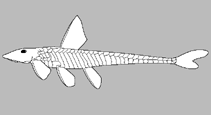
Rückenflossenstacheln (insgesamt) : 2; Rückenflossenweichstrahlen (insgesamt) : 7; Afterflossenstacheln: 1; Afterflossenweichstrahlen: 4. Distinguished from all other Hypostomus except the species of the H. cochliodon group based on the presence of large, spoon-shaped teeth; and from all members of the H. cochliodon group except H. cochliodon, H. ericae, H. ericius and H. paucipunctatus by the presence of very widely spaced black spots on a light background. Can be separated from H. cochliodon by absence of a longitudinal ridge on the pterotic-supracleithrum and absence of longitudinal dark stripes; from H. ericius by lacking keels formed from sharp odontodes on the lateral plates; from H. ericae and H. paucipunctatus by lacking a buccal papilla; from H. ericae by having spots in the distal dorsal and caudal fins not combining (vs. spots combining to form wavy lines); and from H. paucipunctatus by having medium to large spots. It is further distinguished by having seven to eight adipose-caudal plates and by generally having no odontodes on the opercle (zero to 10), vs. having a patch of greater than 10 odontodes on the opercle (Ref. 54531).
Body shape (shape guide): elongated.
Facultative air-breathing in the genus (Ref. 126274); Occurs among submerged, dead wood in modest to swift flowing water (Ref. 54531). Inhabiting largest part of freshwaters, from headwaters to upstream of the lower falls, with rocky substrate consisting of boulders, stones, gravels, and sand; the exposed wet rocks are also often covered by the Podostemaceae Mourera fluviatilis and Apinagia richardiana (Ref. 90186).
Lebenszyklus und Paarungsverhalten
Geschlechtsreife | Fortpflanzung | Ablaichen | Eier | Fruchtbarkeit | Larven
Armbruster, J.W. and L.S. de Souza, 2005. Hypostomus macushi, a new species of the Hypostomus cochliodon group (Siluriformes: Loricariidae) from Guyana. Zootaxa 920:1-12. (Ref. 54531)
IUCN Rote Liste Status (Ref. 130435: Version 2025-2 (Global))
Bedrohung für Menschen
Harmless
Nutzung durch Menschen
Fischereien: nicht kommerziell
Tools
Zusatzinformationen
Download XML
Internet Quellen
Schätzungen auf der Grundlage von Modellen
Phylogenetischer Diversitätsindex (Ref.
82804): PD
50 = 0.5000 [Uniqueness, from 0.5 = low to 2.0 = high].
Bayesian length-weight: a=0.01585 (0.00726 - 0.03460), b=2.95 (2.78 - 3.12), in cm total length, based on LWR estimates for this Genus-body shape (Ref.
93245).
Widerstandsfähigkeit (Ref.
120179): mittel, Verdopplung der Population dauert 1,4 - 4,4 Jahre. (Preliminary K or Fecundity.).
Anfälligkeit der Fischerei (Ref.
59153): Low vulnerability (11 of 100).
🛈