Classificatie / Namen
Lokale namen | Synoniemen | Catalog of Fishes(Genus, Soort(en)) | ITIS | CoL | WoRMS | Cloffa
>
Eupercaria/misc (Various families in series Eupercaria) >
Labridae (Wrasses) > Scarinae
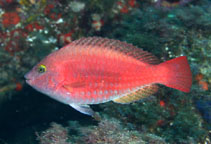
Etymology: Sparisoma: Latin, sparus = a fish with a golden head + Greek, soma = body (Ref. 45335); tuiupiranga: From the Tupi for 'red parakeet', the native American language once spoken along the Brazilian coast, and refers to the splendid color of initial phase adults of this small parrotfish.
Milieu: milieu / Klimaatzone / Diepte / verspreidingsgebied
Ecologie
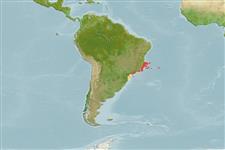
marien rifbewoner; diepte 5 - 20 m (Ref. 52151). Subtropical; 17°S - 28°S
Southwestern Atlantic: from the state of Bahia (Abrolhos Archipelago National Marine Park to the state of Santa Catarina), Brazil.
Grootte / Gewicht / Leeftijd
Maturiteit: Lm ? range ? - ? cm
Max length : 15.4 cm SL mannelijk / geslacht onbekend; (Ref. 52151)
Found in shallow areas of tropical rocky reefs. Males establish territories (approximately 8 m2). Juveniles are strongly associated with seaweed beds, occasionally found mixed with Sparisoma radians and Cryptotomus roseus. This species is typically a scraper which grazes upon a large variety of epilithic algae (e.g. Jania, Gelidium, Polysiphonia, consequently ingesting a large quantity of sediment. It is however, very plastic in its feeding habits and is commonly observed browsing over Sargassum. Males and larger initial phase adult individuals perform up to 2400 bites daily with a mean gut turnover of about 2.5 guts day-1, having an important role on local energy flux (Ref. 52151).
Levenscyclus en paargedrag
Maturiteit | Voortplanting | Paaien | Eieren | Fecunditeit | Larven
Gasparini, J.L., J.-C. Joyeux and S.R. Floeter, 2003. Sparisoma tuiupiranga, a new species of parrotfish (Perciformes: Labroidei: Scaridae) from Brazil, with comments on the evolution of the genus. Zootaxa 384:1-14. (Ref. 52151)
Status op de Rode Lijst van het IUCN (Ref. 130435: Version 2025-2 (Global))
Gevaar voor de mens
Harmless
Gebruik door de mens
Tools
Speciale rapporten
Download XML
Internetbronnen
Schattingen op basis van modellen
Gewenste temperatuur (Ref.
123201): 23.4 - 26.4, mean 25.8 °C (based on 67 cells).
Fylogenetische diversiteitsindex (Ref.
82804): PD
50 = 0.5000 [Uniqueness, from 0.5 = low to 2.0 = high].
Bayesian length-weight: a=0.01778 (0.01068 - 0.02961), b=3.10 (2.96 - 3.24), in cm total length, based on LWR estimates for this species & Genus-body shape (Ref.
93245).
Trofisch niveau (Ref.
69278): 2.0 ±0.00 se; based on food items.
Weerstandsvermogen (Ref.
120179): Hoog, minimale populatieverdubbelingstijd minder dan 15 maanden (Preliminary K or Fecundity.).
Kwetsbaarheid van de visserij (Ref.
59153): Low vulnerability (10 of 100).
🛈