Myxini (peixes-bruxa) (hagfishes) >
Myxiniformes (Hagfishes) >
Myxinidae (Hagfishes) > Eptatretinae
Etymology: Eptatretus: hepta (Gr.), seven; tretos (Gr.), perforated (i.e., with holes), referring to seven gill apertures on what would later be described as Homea banksii (=E. cirrhatus) [range within genus is 6-14 pairs of gill apertures] (See ETYFish); luzonicus: -icus (Gr.), belonging to: Luzon Island, Philippines, type locality [replacement name of E. fernholmi McMillan & Wisner 2004, which became a junior homonym of Paramyxine fernholmi Kuo, Huang & Mok 1994 when Paramyxine was subsumed into Eptatretus] (See ETYFish).
Meio ambiente: milieu / Zona climática / intervalo de profundidade / faixa de distribuição
Ecologia
marinhas batidemersal; não migratória; intervalo de profundidade 563 - 710 m (Ref. 95645). Deep-water; 7°C - ? (Ref. 95645); 20°N - 5°N, 116°E - 128°E
Western Pacific: known only from the type locality in the Philippines.
Tamanho / Peso / Idade
Maturidade: Lm ? range ? - ? cm
Max length : 37.3 cm TL macho/indeterminado; (Ref. 95645); 56.3 cm TL (female)
Descrição suscinta
Chaves de identificação | Morfologia | Morfometria
This species can be distinguished from its known congeners by the following set of characters: gill pouches 8 pairs; 3-cusp multicusps on the anterior sets and 2-cusp multicusps on the posterior sets of cusps; total cusps 47-51; prebranchial pores 13-15; trunk pores 49-55; total pores 84-88; a single nasal-sinus papilla in the middorsal surface of the nasal sinus (Ref. 95645).
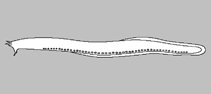
Body shape (shape guide): eel-like; Cross section: oval.
The holotype was collected from the type locality over green muddy bottom at bottom temperature of 6.8°C, surface water temperature 28.3°C (Anonymous, 1910). Additional specimens from the Verde Island Passage were collected at 578 and 710 m, sediment type ranged from mud to sand (Ref. 95645).
Ciclo de vida ou comportamento de acasalamento
Maturidade | Reprodução | Desova | Ovos | Fecundidade | Larvas
Mincarone, M.M. and J.E. McCosker, 2014. Redescription of Eptatretus luzonicus Fernholm et al., 2013, a replacement name for Eptratretus fernholmi McMillan and Wisner, 2004 (Craniata: Myxinidae), based on the discovery of the holotype and additional specimens from the Philippines. pp. 341-349. In Williams, G.C. and T.M. Gosliner, eds. 2014. The Coral Triangle : The 2011 Hearst Biodiverisity Philippine Expedition. California Academy of Sciences, San Francisco, California 94118, USA. (Ref. 95645)
Status na Lista Vermelha da UICN (Ref. 130435: Version 2025-2 (Global))
Ameaça para os humanos
Harmless
Uso pelos humanos
Pescarias: sem interesse
Ferramentas
Relatórios especiais
Baixar XML
Fontes da internet
Estimativas baseadas em modelos
Índice de diversidade filogenética (Ref.
82804): PD
50 = 0.5000 [Uniqueness, from 0.5 = low to 2.0 = high].
Bayesian length-weight: a=0.00204 (0.00094 - 0.00444), b=2.92 (2.72 - 3.12), in cm total length, based on LWR estimates for this (Sub)family-body shape (Ref.
93245).
Nível Trófico (Ref.
69278): 4.2 ±0.7 se; based on size and trophs of closest relatives
Resiliência (Ref.
120179): Baixo, tempo mínimo de duplicação da população 4,5 - 14 anos (Fec assumed to be <100).
Vulnerabilidade da pesca (Ref.
59153): Moderate vulnerability (43 of 100).
🛈