Myxines (hagfishes) >
Myxiniformes (Hagfishes) >
Myxinidae (Hagfishes) > Eptatretinae
Etymology: Eptatretus: hepta (Gr.), seven; tretos (Gr.), perforated (i.e., with holes), referring to seven gill apertures on what would later be described as Homea banksii (=E. cirrhatus) [range within genus is 6-14 pairs of gill apertures] (See ETYFish); luzonicus: -icus (Gr.), belonging to: Luzon Island, Philippines, type locality [replacement name of E. fernholmi McMillan & Wisner 2004, which became a junior homonym of Paramyxine fernholmi Kuo, Huang & Mok 1994 when Paramyxine was subsumed into Eptatretus] (See ETYFish).
Environnement : milieu / zone climatique / profondeur / gamme de distribution
Écologie
marin bathydémersal; non migrateur; profondeur 563 - 710 m (Ref. 95645). Deep-water; 7°C - ? (Ref. 95645); 20°N - 5°N, 116°E - 128°E
Western Pacific: known only from the type locality in the Philippines.
Taille / Poids / Âge
Maturité: Lm ? range ? - ? cm
Max length : 37.3 cm TL mâle / non sexé; (Ref. 95645); 56.3 cm TL (female)
Description synthétique
Clés d'identification | Morphologie | Morphométrie
This species can be distinguished from its known congeners by the following set of characters: gill pouches 8 pairs; 3-cusp multicusps on the anterior sets and 2-cusp multicusps on the posterior sets of cusps; total cusps 47-51; prebranchial pores 13-15; trunk pores 49-55; total pores 84-88; a single nasal-sinus papilla in the middorsal surface of the nasal sinus (Ref. 95645).
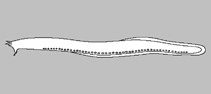
Body shape (shape guide): eel-like; Cross section: oval.
The holotype was collected from the type locality over green muddy bottom at bottom temperature of 6.8°C, surface water temperature 28.3°C (Anonymous, 1910). Additional specimens from the Verde Island Passage were collected at 578 and 710 m, sediment type ranged from mud to sand (Ref. 95645).
Cycle de vie et comportement reproducteur
Maturité | Reproduction | Frai | Œufs | Fécondité | Larves
Mincarone, M.M. and J.E. McCosker, 2014. Redescription of Eptatretus luzonicus Fernholm et al., 2013, a replacement name for Eptratretus fernholmi McMillan and Wisner, 2004 (Craniata: Myxinidae), based on the discovery of the holotype and additional specimens from the Philippines. pp. 341-349. In Williams, G.C. and T.M. Gosliner, eds. 2014. The Coral Triangle : The 2011 Hearst Biodiverisity Philippine Expedition. California Academy of Sciences, San Francisco, California 94118, USA. (Ref. 95645)
Statut dans la liste rouge de l'IUCN (Ref. 130435: Version 2025-2 (Global))
Menace pour l'homme
Harmless
Utilisations par l'homme
Pêcheries: sans intérêt
Outils
Articles particuliers
Télécharger en XML
Sources Internet
Estimations basées sur des modèles
Indice de diversité phylogénétique (Réf.
82804): PD
50 = 0.5000 [Uniqueness, from 0.5 = low to 2.0 = high].
Bayesian length-weight: a=0.00204 (0.00094 - 0.00444), b=2.92 (2.72 - 3.12), in cm total length, based on LWR estimates for this (Sub)family-body shape (Ref.
93245).
Niveau trophique (Réf.
69278): 4.2 ±0.7 se; based on size and trophs of closest relatives
Résilience (Réf.
120179): Faible, temps minimum de doublement de population : 4,5 à 14 années (Fec assumed to be <100).
Vulnérabilité de la pêche (Ref.
59153): Moderate vulnerability (43 of 100).
🛈