>
Perciformes/Scorpaenoidei (Scorpionfishes) >
Tetrarogidae (Wasp fishes)
Etymology: Neocentropogon: Greek, neos = new + Greek, kentron = sting + Greek, pogon = beard (Ref. 45335).
Eponymy: This is not an eponym but an acronym that relates to a number of Red Sea explorations, known as: Metalliferous Sediments Atlantis-II-Deep, or MESEDA, which consisted of three cruises (1977–1981). The type was taken during one of these. (Ref. 128868), visit book page.
Ambiente: milieu / zona climática / intervalo de profundidade / gama de distribuição
Ecologia
marinhas batidemersal; intervalo de profundidade 300 - 383 m (Ref. 122804). Deep-water
Western Indian Ocean: apparently endemic in the Red Sea, Saudi Arabia and Israel.
Tamanho / Peso / Idade
Maturidade: Lm ? range ? - ? cm
Max length : 6.5 cm SL macho/indeterminado; (Ref. 122804)
Descrição breve
Chaves de identificação | Morfologia | Morfometria
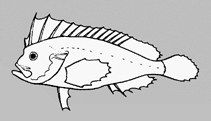
Espinhos dorsais (total) : 13; Raios dorsais moles (total) : 8; Espinhos anais: 3; Raios anais moles: 5. This species have the following characters: lacrymal with 2 spines and low nuchal ridge is without spine; pterotic, posttemporal and humeral have 1 spine each; two convex interorbital ridges with no spines, closest together above the centre of orbit; preopercle with 5 spines, the uppermost is the largest; opercle with 2 ridges, the upper ending in a spine; lower jaw protruding, with a small knob at the symphysis; gill rakers 9-10 + 1; lateral-line scales 22-23; dorsal fin beginning on the level of the posterior end of the pupil; D XIII,8 with the last ray attached to caudal peduncle by a membrane; A III,5 with the last ray attached to caudal peduncle by a membrane; pectoral-fin rays i,10,iii-iv (total 14-15); pelvic-fin I,5. Colouration: head and body light brown, the sides pale brown belly whitish; eye dark grey; peritoneum pale; dorsal fin light brown, membranes of spinous section distally blackish with the soft dorsal transparent, with irregular brown spots arranged in three oblique rows; anal fin pale, the membranes of spinous section distally dark brown, distal one-third of soft section with irregular
brown spots; pectoral fin with a basal brown blotch, an upper central vertical row of dark brown spots, distal one-third brown, with irregularly arranged dark brown spots; pelvic fin distally blackish; caudal fin pale, the upper half with 6 rows of irregularly arranged brown spots, lower half with four such rows, distal one-fourth dark brown (Ref. 122804).
Cross section: compressed.
Ciclo de vida e comportamento de acasalamento
Maturidade | Reprodução | Desova | Ovos | Fecundidade | Larvas
Goren, M. and M. Dor, 1994. An updated checklist of the fishes of the Red Sea (CLOFRES II). The Israel Academy of Sciences and Humanities, Jerusalem, Israel. 120 p. (Ref. 12541)
Categoria na Lista Vermelha da IUCN (Ref. 130435: Version 2025-2 (Global))
Ameaça para o homem
Harmless
Utilização humana
Ferramentas
Relatórios especiais
Descarregue XML
Fontes da internet
Estimativas baseadas em modelos
Índice de diversidade filogenética (Ref.
82804): PD
50 = 0.5156 [Uniqueness, from 0.5 = low to 2.0 = high].
Bayesian length-weight: a=0.01122 (0.00514 - 0.02450), b=3.04 (2.87 - 3.21), in cm total length, based on all LWR estimates for this body shape (Ref.
93245).
Nível Trófico (Ref.
69278): 3.2 ±0.3 se; based on size and trophs of closest relatives
Resiliência (Ref.
120179): Médio, tempo mínimo de duplicação da população 1,4 - 4,4 anos (Preliminary K or Fecundity.).
Vulnerabilidade da pesca (Ref.
59153): Low vulnerability (10 of 100).
🛈