>
Perciformes/Scorpaenoidei (Scorpionfishes) >
Tetrarogidae (Wasp fishes)
Etymology: Neocentropogon: Greek, neos = new + Greek, kentron = sting + Greek, pogon = beard (Ref. 45335).
Eponymy: This is not an eponym but an acronym that relates to a number of Red Sea explorations, known as: Metalliferous Sediments Atlantis-II-Deep, or MESEDA, which consisted of three cruises (1977–1981). The type was taken during one of these. (Ref. 128868), visit book page.
Lingkungan: lingkungan / zona iklim / kisaran kedalaman / jangkauan distribusi
Ekologi
laut batidemersal; kisaran kedalaman 300 - 383 m (Ref. 122804). Deep-water
Western Indian Ocean: apparently endemic in the Red Sea, Saudi Arabia and Israel.
Ukuran / Berat / umur
Kematangan: Lm ? range ? - ? cm
Max length : 6.5 cm SL jantan/; (Ref. 122804)
deskripsi pendek
Kunci identifiaksi (pengenalan) | Morfologi | Morfometrik
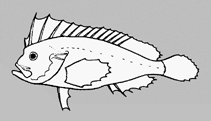
Duri punggung (Keseluruhan (total)) : 13; duri punggung lunak (Keseluruhan (total)) : 8; Duri dubur: 3; Sirip dubur lunak: 5. This species have the following characters: lacrymal with 2 spines and low nuchal ridge is without spine; pterotic, posttemporal and humeral have 1 spine each; two convex interorbital ridges with no spines, closest together above the centre of orbit; preopercle with 5 spines, the uppermost is the largest; opercle with 2 ridges, the upper ending in a spine; lower jaw protruding, with a small knob at the symphysis; gill rakers 9-10 + 1; lateral-line scales 22-23; dorsal fin beginning on the level of the posterior end of the pupil; D XIII,8 with the last ray attached to caudal peduncle by a membrane; A III,5 with the last ray attached to caudal peduncle by a membrane; pectoral-fin rays i,10,iii-iv (total 14-15); pelvic-fin I,5. Colouration: head and body light brown, the sides pale brown belly whitish; eye dark grey; peritoneum pale; dorsal fin light brown, membranes of spinous section distally blackish with the soft dorsal transparent, with irregular brown spots arranged in three oblique rows; anal fin pale, the membranes of spinous section distally dark brown, distal one-third of soft section with irregular
brown spots; pectoral fin with a basal brown blotch, an upper central vertical row of dark brown spots, distal one-third brown, with irregularly arranged dark brown spots; pelvic fin distally blackish; caudal fin pale, the upper half with 6 rows of irregularly arranged brown spots, lower half with four such rows, distal one-fourth dark brown (Ref. 122804).
Cross section: compressed.
Siklus hidup dan perilaku kawin
Kematangan | Reproduksi, perkembang biakan | Pemijahan | telur-telur | Fekunditas | Larva
Goren, M. and M. Dor, 1994. An updated checklist of the fishes of the Red Sea (CLOFRES II). The Israel Academy of Sciences and Humanities, Jerusalem, Israel. 120 p. (Ref. 12541)
Status IUCN Red List (Ref. 130435: Version 2025-2 (Global))
ancaman kepada manusia
Harmless
penggunaan manusia
Alat, peralatan
laporan khas
muat turun XML
Sumber internet
Estimasi berdasarkan model
Indeks keanekaragaman filogenetik (Acuan
82804): PD
50 = 0.5156 [Uniqueness, from 0.5 = low to 2.0 = high].
Bayesian length-weight: a=0.01122 (0.00514 - 0.02450), b=3.04 (2.87 - 3.21), in cm total length, based on all LWR estimates for this body shape (Ref.
93245).
Tingkat Trofik (Acuan
69278): 3.2 ±0.3 se; based on size and trophs of closest relatives
Daya lenting (Acuan
120179): sedang, Waktu penggandaan populasi minimum 1.4 - 4.4 tahun (Preliminary K or Fecundity.).
Kerentanan Penangkapan Ikan (Ref.
59153): Low vulnerability (10 of 100).
🛈