Classificação / Nomes
Nomes comuns | Sinónimos | Catalog of Fishes(Género, Espécies) | ITIS | CoL | WoRMS | Cloffa
>
Stomiiformes (Lightfishes and dragonfishes) >
Stomiidae (Barbeled dragonfishes) > Astronesthinae
Etymology: Astronesthes: Greek, astra = ray + Greek, esthes, -es = suit, something used to wrap (Ref. 45335); zharovi: Named after V.L. Zharov, one of the first national investigators of the epipelagial of the World Ocean (Ref. 30704).
Eponymy: Dr Viktor L Zharov (1932–1998) was a Russian ichthyologist at the Atlantic Research Institute of Marine Fisheries and Oceanography, Kaliningrad, and a specialist in scombroid fishes. [...] (Ref. 128868), visit book page.
Ambiente: milieu / zona climática / intervalo de profundidade / gama de distribuição
Ecologia
marinhas batipelágico; intervalo de profundidade ? - 600 m (Ref. 58018). Deep-water; 27°N - 17°S
Atlantic Ocean: known only between the eastern part of the Gulf of Mexico (27°N, 86°W) and southern Angola (17°S, 10°E).
Tamanho / Peso / Idade
Maturidade: Lm ? range ? - ? cm
Max length : 11.0 cm SL (female)
Descrição breve
Chaves de identificação | Morfologia | Morfometria
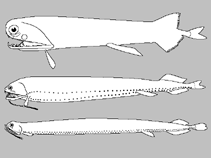
Espinhos dorsais (total) : 0; Raios dorsais moles (total) : 12 - 13; Espinhos anais: 0; Raios anais moles: 11 - 13; Vértebras: 45 - 46. Chin barbel half as long as the head and bears a small explanate bulb lacking appendages. Base of anal fin significantly behind the vertical of the dorsal fin end. Postorbital organ large and angled at 20°-30° with respect to the longitudinal body axis. It extends behind the vertical of the back side of the orbit and is covered from above with a pigmented fold of skin. Bunch-like aggregation of luminous spots proceeds down and to the rear from the back tip of the postorbital organ. Numerous spots of luminous tissue on head, the gill cover, back of the head, around the chin area, on the jaws, as well as on the front side of the body, behind the head, and above and below the lateral row of photophores. Serial photophores are not large and form no clear bends or steps (Ref. 30704).
Body shape (shape guide): elongated.
Ciclo de vida e comportamento de acasalamento
Maturidade | Reprodução | Desova | Ovos | Fecundidade | Larvas
Parin, N.V. and O.D. Borodulina, 1998. A new mesopelagic fish Astronesthes zharovi (Astronesthidae, Stomiiformes) from tropical Atlantic. J. Ichthyol. 38(8):669-672. (Ref. 30704)
Categoria na Lista Vermelha da IUCN (Ref. 130435: Version 2025-2 (Global))
Ameaça para o homem
Harmless
Utilização humana
Ferramentas
Relatórios especiais
Descarregue XML
Fontes da internet
Estimativas baseadas em modelos
Índice de diversidade filogenética (Ref.
82804): PD
50 = 0.5000 [Uniqueness, from 0.5 = low to 2.0 = high].
Bayesian length-weight: a=0.00407 (0.00167 - 0.00996), b=3.05 (2.83 - 3.27), in cm total length, based on LWR estimates for this (Sub)family-body shape (Ref.
93245).
Nível Trófico (Ref.
69278): 3.8 ±0.6 se; based on size and trophs of closest relatives
Resiliência (Ref.
120179): Elevada, tempo mínimo de duplicação da população menor que 15 meses (Preliminary K or Fecundity.).
Vulnerabilidade da pesca (Ref.
59153): Low vulnerability (10 of 100).
🛈