Klassifizierung / Names
Namen | Synonyme | Catalog of Fishes(Gattung, Arten) | ITIS | CoL | WoRMS | Cloffa
>
Stomiiformes (Lightfishes and dragonfishes) >
Stomiidae (Barbeled dragonfishes) > Astronesthinae
Etymology: Astronesthes: Greek, astra = ray + Greek, esthes, -es = suit, something used to wrap (Ref. 45335); zharovi: Named after V.L. Zharov, one of the first national investigators of the epipelagial of the World Ocean (Ref. 30704).
Eponymy: Dr Viktor L Zharov (1932–1998) was a Russian ichthyologist at the Atlantic Research Institute of Marine Fisheries and Oceanography, Kaliningrad, and a specialist in scombroid fishes. [...] (Ref. 128868), visit book page.
Umwelt: Milieu / Klimazone / Tiefenbereich / Verbreitungsgebiet
Ökologie
seewasser bathypelagisch; tiefenbereich ? - 600 m (Ref. 58018). Deep-water; 27°N - 17°S
Atlantic Ocean: known only between the eastern part of the Gulf of Mexico (27°N, 86°W) and southern Angola (17°S, 10°E).
Größe / Gewicht / Alter
Geschlechtsreife: Lm ? range ? - ? cm
Max length : 11.0 cm SL (female)
Kurzbeschreibung
Bestimmungsschlüssel | Morphologie | Morphometrie
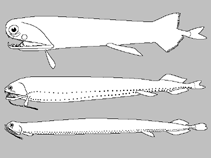
Rückenflossenstacheln (insgesamt) : 0; Rückenflossenweichstrahlen (insgesamt) : 12 - 13; Afterflossenstacheln: 0; Afterflossenweichstrahlen: 11 - 13; Wirbelzahl: 45 - 46. Chin barbel half as long as the head and bears a small explanate bulb lacking appendages. Base of anal fin significantly behind the vertical of the dorsal fin end. Postorbital organ large and angled at 20°-30° with respect to the longitudinal body axis. It extends behind the vertical of the back side of the orbit and is covered from above with a pigmented fold of skin. Bunch-like aggregation of luminous spots proceeds down and to the rear from the back tip of the postorbital organ. Numerous spots of luminous tissue on head, the gill cover, back of the head, around the chin area, on the jaws, as well as on the front side of the body, behind the head, and above and below the lateral row of photophores. Serial photophores are not large and form no clear bends or steps (Ref. 30704).
Body shape (shape guide): elongated.
Lebenszyklus und Paarungsverhalten
Geschlechtsreife | Fortpflanzung | Ablaichen | Eier | Fruchtbarkeit | Larven
Parin, N.V. and O.D. Borodulina, 1998. A new mesopelagic fish Astronesthes zharovi (Astronesthidae, Stomiiformes) from tropical Atlantic. J. Ichthyol. 38(8):669-672. (Ref. 30704)
IUCN Rote Liste Status (Ref. 130435: Version 2025-2 (Global))
Bedrohung für Menschen
Harmless
Nutzung durch Menschen
Tools
Zusatzinformationen
Download XML
Internet Quellen
Schätzungen auf der Grundlage von Modellen
Phylogenetischer Diversitätsindex (Ref.
82804): PD
50 = 0.5000 [Uniqueness, from 0.5 = low to 2.0 = high].
Bayesian length-weight: a=0.00407 (0.00167 - 0.00996), b=3.05 (2.83 - 3.27), in cm total length, based on LWR estimates for this (Sub)family-body shape (Ref.
93245).
Trophische Ebene (Ref.
69278): 3.8 ±0.6 se; based on size and trophs of closest relatives
Widerstandsfähigkeit (Ref.
120179): hoch, Verdopplung der Population dauert weniger als 15 Monate. (Preliminary K or Fecundity.).
Anfälligkeit der Fischerei (Ref.
59153): Low vulnerability (10 of 100).
🛈