>
Gobiiformes (Gobies) >
Gobiidae (Gobies) > Gobiinae
Etymology: Trimmatom: Greek, trimma, -atos = something crushed + Greek, tomos = cut (Ref. 45335).
More on author: Winterbottom.
Environnement : milieu / zone climatique / profondeur / gamme de distribution
Écologie
marin récifal; profondeur 0 - 28 m (Ref. 90102). Tropical
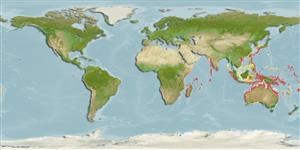
Indo-West Pacific: Seychelles, Cargados Carajos, Chagos Archipelago to Sumatra and the Philippines, north to Japan, south to Papua New Guinea, the Solomon Islands, and the Timor Sea.
Taille / Poids / Âge
Maturité: Lm ? range ? - ? cm
Max length : 2.2 cm TL mâle / non sexé; (Ref. 90102)
Description synthétique
Clés d'identification | Morphologie | Morphométrie
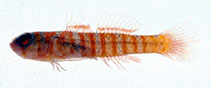
Épines dorsales (Total) : 6; Rayons mous dorsaux (Total) : 9; Rayons mous anaux: 9. Trimmatom pharus differs from T. nanus, T. offucius, and T. sagma in possessing scales on the body (vs naked) and branched pelvic fin rays (vs unbranched). Trimmatom zapotes, T. macropodus, and T. pharus all have body scales but T. zapotes has unbranched pelvic fin rays, and T. macropodus has the first four pelvic fin rays branched. Trimmatom pharus shares many meristic characteristics with T. eviotops including the presence of body scales and the branching of the first four pelvic fin rays; the two species do, however, differ in details of colour pattern. In preserved specimens the first body bar on T. eviotops crosses the pectoral base and the extends over the dorsum, passing backwards to the dorsal fin. In Trimmatom pharus the body bar which crosses the pectoral base crosses the dorsal surface anterior to the dorsal fin. Trimmatom eviotops has a broad dark saddle on the dorsall half of the caudal peduncle, while Trimmatom pharus has a narrow body bar or small dark saddle (Ref. 52310).
Body shape (shape guide): elongated; Cross section: compressed.
Inhabits shoals, reefs and lagoons in 0-28 m (Ref. 90102).
Cycle de vie et comportement reproducteur
Maturité | Reproduction | Frai | Œufs | Fécondité | Larves
Winterbottom, R., 2001. Two new gobiid fish species in Trimma and Trimmatom (Teleostei: Gobiidae) from the Indian and Western Pacific Oceans. aqua, J. Ichthyol. Aquat. Biol. 5(1):19-24. (Ref. 52310)
Statut dans la liste rouge de l'IUCN (Ref. 130435: Version 2025-2 (Global))
Menace pour l'homme
Harmless
Utilisations par l'homme
Pêcheries: sans intérêt
Outils
Articles particuliers
Télécharger en XML
Sources Internet
Estimations basées sur des modèles
Température préférée (Réf.
123201): 23.5 - 29.3, mean 28.2 °C (based on 2040 cells).
Indice de diversité phylogénétique (Réf.
82804): PD
50 = 0.5078 [Uniqueness, from 0.5 = low to 2.0 = high].
Bayesian length-weight: a=0.00741 (0.00347 - 0.01582), b=3.09 (2.91 - 3.27), in cm total length, based on LWR estimates for this (Sub)family-body shape (Ref.
93245).
Niveau trophique (Réf.
69278): 3.0 ±0.3 se; based on size and trophs of closest relatives
Résilience (Réf.
120179): Haut, temps minimum de doublement de population inférieur à 15 mois (Preliminary K or Fecundity.).
Vulnérabilité de la pêche (Ref.
59153): Low vulnerability (10 of 100).
🛈