>
Gobiiformes (Gobies) >
Gobiidae (Gobies) > Gobiinae
Etymology: Trimmatom: Greek, trimma, -atos = something crushed + Greek, tomos = cut (Ref. 45335).
More on author: Winterbottom.
Milieu: milieu / Klimaatzone / Diepte / verspreidingsgebied
Ecologie
marien rifbewoner; diepte 0 - 28 m (Ref. 90102). Tropical
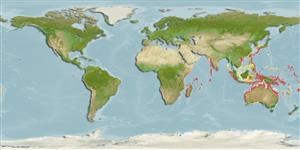
Indo-West Pacific: Seychelles, Cargados Carajos, Chagos Archipelago to Sumatra and the Philippines, north to Japan, south to Papua New Guinea, the Solomon Islands, and the Timor Sea.
Grootte / Gewicht / Leeftijd
Maturiteit: Lm ? range ? - ? cm
Max length : 2.2 cm TL mannelijk / geslacht onbekend; (Ref. 90102)
Korte beschrijving
Determinatiesleutels | Morfologie | Morfometrie
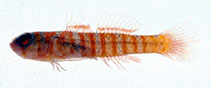
Dorsale stekels (totaal) : 6; Dorsale zachte stralen (totaal) : 9; Anale zachte stralen: 9. Trimmatom pharus differs from T. nanus, T. offucius, and T. sagma in possessing scales on the body (vs naked) and branched pelvic fin rays (vs unbranched). Trimmatom zapotes, T. macropodus, and T. pharus all have body scales but T. zapotes has unbranched pelvic fin rays, and T. macropodus has the first four pelvic fin rays branched. Trimmatom pharus shares many meristic characteristics with T. eviotops including the presence of body scales and the branching of the first four pelvic fin rays; the two species do, however, differ in details of colour pattern. In preserved specimens the first body bar on T. eviotops crosses the pectoral base and the extends over the dorsum, passing backwards to the dorsal fin. In Trimmatom pharus the body bar which crosses the pectoral base crosses the dorsal surface anterior to the dorsal fin. Trimmatom eviotops has a broad dark saddle on the dorsall half of the caudal peduncle, while Trimmatom pharus has a narrow body bar or small dark saddle (Ref. 52310).
Body shape (shape guide): elongated; Cross section: compressed.
Inhabits shoals, reefs and lagoons in 0-28 m (Ref. 90102).
Levenscyclus en paargedrag
Maturiteit | Voortplanting | Paaien | Eieren | Fecunditeit | Larven
Winterbottom, R., 2001. Two new gobiid fish species in Trimma and Trimmatom (Teleostei: Gobiidae) from the Indian and Western Pacific Oceans. aqua, J. Ichthyol. Aquat. Biol. 5(1):19-24. (Ref. 52310)
Status op de Rode Lijst van het IUCN (Ref. 130435: Version 2025-2 (Global))
Gevaar voor de mens
Harmless
Gebruik door de mens
Visserij: van geen belang
Tools
Speciale rapporten
Download XML
Internetbronnen
Schattingen op basis van modellen
Gewenste temperatuur (Ref.
123201): 23.5 - 29.3, mean 28.2 °C (based on 2040 cells).
Fylogenetische diversiteitsindex (Ref.
82804): PD
50 = 0.5078 [Uniqueness, from 0.5 = low to 2.0 = high].
Bayesian length-weight: a=0.00741 (0.00347 - 0.01582), b=3.09 (2.91 - 3.27), in cm total length, based on LWR estimates for this (Sub)family-body shape (Ref.
93245).
Trofisch niveau (Ref.
69278): 3.0 ±0.3 se; based on size and trophs of closest relatives
Weerstandsvermogen (Ref.
120179): Hoog, minimale populatieverdubbelingstijd minder dan 15 maanden (Preliminary K or Fecundity.).
Kwetsbaarheid van de visserij (Ref.
59153): Low vulnerability (10 of 100).
🛈