>
Blenniiformes (Blennies) >
Blenniidae (Combtooth blennies) > Blenniinae
Etymology: Aspidontus: Greek, aspis, -idos = shield + Latin, dens, dentis = teeth (Ref. 45335).
More on authors: Quoy & Gaimard.
Окружающая среда: среда / климатическая зона / пределы глубины / диапазон распространения
экология
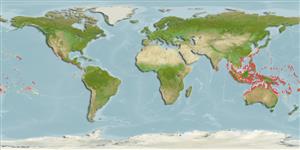
морской ассоциированный с рифами; пределы глубины 1 - 25 m (Ref. 90102). Tropical; 32°N - 32°S
Indo-Pacific.
Размер / Вес / Возраст
половая зрелость: Lm ? range ? - ? cm
Max length : 11.5 cm TL самец/пол неопределен; (Ref. 9710)
Краткое описание
определительные ключи | морфология | морфометрия
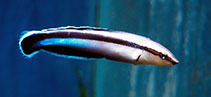
колючие лучи спинного плавника (общее число) : 10 - 12; членистые (мягкие) лучи спинного плавника (общее число) : 26 - 28; колючие лучи анального плавника: 2; членистые (мягкие) лучи анального плавника: 25 - 28. Bears an amazing resemblance to the cleaner wrasse, Labroides dimidiatus. Distinguished from L. dimidiatus by the position of its mouth, which is terminal in the wrasse but under the snout in the blenny.
Body shape (shape guide): elongated.
Adults are found solitary or in small groups (Ref. 90102) in lagoons, subtidal reef flats and outer reef slopes (where it occurs to depths of over 20 m). Often in pairs in empty worm tubes or narrow holes. They mimic the cleaner wrasse Labroides dimidiatus and nip fins, skin and scales of other fishes (Ref. 9710). They even copy the motion of the cleaner wrasse that may induce other fish to come close, then target their scales or mucus for a feed, biting and quickly retreating to the corals before the victim realizes that it was tricked; experienced fish recognize imposters and often give it a chase (Ref. 48636). Diet is supplemented with benthic invertebrates and zooplankton (Ref. 94105). Also feed on tubeworms and demersal fish eggs. Oviparous. Eggs are demersal and adhesive (Ref. 205), and are attached to the substrate via a filamentous, adhesive pad or pedestal (Ref. 94114). Larvae are planktonic, often found in shallow, coastal waters (Ref. 94114).
Жизненный цикл и брачное поведение
половая зрелость | размножение | нерест | икра | Плодовитость | личинки
Distinct pairing (Ref. 205).
Smith-Vaniz, W.F., B.C. Victor and G.R. Allen, 2020. Aggressive mimicry in Aspidontus and Plagiotremus (Pisces: Blenniidae): some mimetic phenotypes are not phylogenetically informative. J. Ocean Sci. Found. 35:118-128. (Ref. 123078)
Статус Красного Списка МСОП (Ref. 130435: Version 2025-2 (Global))
Угроза для людей
Harmless
Использование человеком
рыболовство: коммерческий; аквариум: коммерческий
дополнительная информация
инструменты
Специальные отчеты
Скачать в формате XML
ресурсы в Интернет
Оценки, основанные на моделях
Предпочтительная температура (ссылка
123201): 25.1 - 29.3, mean 28.5 °C (based on 2575 cells).
Индекс филогенетического разнообразия (ссылка
82804): PD
50 = 0.7500 [Uniqueness, from 0.5 = low to 2.0 = high].
Bayesian length-weight: a=0.00575 (0.00255 - 0.01297), b=3.06 (2.87 - 3.25), in cm total length, based on LWR estimates for this (Sub)family-body shape (Ref.
93245).
Трофический уровень (ссылка
69278): 3.8 ±0.51 se; based on food items.
устойчивость к внешним воздействиям (ссылка
120179): высокий, минимальное время удвоения популяции до 15 месяцев (Preliminary K or Fecundity.).
Уязвимость рыбной ловли (Ref.
59153): Low vulnerability (10 of 100).
🛈
Питательные вещества (Ref.
124155): Calcium = 122 [63, 203] mg/100g; Iron = 0.806 [0.483, 1.330] mg/100g; Protein = 18.4 [17.3, 19.4] %; Omega3 = 0.103 [0.058, 0.181] g/100g; Selenium = 22.6 [11.3, 49.0] μg/100g; VitaminA = 225 [82, 635] μg/100g; Zinc = 1.57 [1.05, 2.26] mg/100g (wet weight);