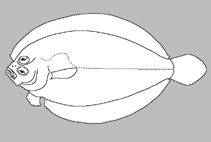
>
Pleuronectiformes (Flatfishes) >
Bothidae (Lefteye flounders)
Etymology: Arnoglossus: Greek, aros, -oy = lamb + Greek, glossa = tongue (Ref. 45335).
Eponymy: Philip Armstrong – about whom we know nothing other than the etymology’s statement that the holotype was caught at Bridport, northern Tasmania “…by Mr Philip Armstrong, in whose honour the species is named.” (Ref. 128868), visit book page.
Meio ambiente: milieu / Zona climática / intervalo de profundidade / faixa de distribuição
Ecologia
marinhas demersal. Temperate
Eastern Indian Ocean: Tasmania, Australia.
Tamanho / Peso / Idade
Maturidade: Lm ? range ? - ? cm
Max length : 16.9 cm SL macho/indeterminado; (Ref. 13746)
Ciclo de vida ou comportamento de acasalamento
Maturidade | Reprodução | Desova | Ovos | Fecundidade | Larvas
Amaoka, K., M. Arai and M. Gomon, 1997. A new species of Arnoglossus (Pleuronectiformes: Bothidae) from the southwestern coast of Australia. Ichthyol. Res. 44(2):131-136. (Ref. 13746)
Status na Lista Vermelha da UICN (Ref. 130435: Version 2025-2 (Global))
Ameaça para os humanos
Harmless
Uso pelos humanos
Ferramentas
Relatórios especiais
Baixar XML
Fontes da internet
Estimativas baseadas em modelos
Índice de diversidade filogenética (Ref.
82804): PD
50 = 0.5000 [Uniqueness, from 0.5 = low to 2.0 = high].
Bayesian length-weight: a=0.00912 (0.00412 - 0.02018), b=3.05 (2.87 - 3.23), in cm total length, based on LWR estimates for this (Sub)family-body shape (Ref.
93245).
Nível Trófico (Ref.
69278): 3.6 ±0.4 se; based on size and trophs of closest relatives
Resiliência (Ref.
120179): médio(a), tempo mínimo de duplicação da população 1,4 - 4,4 anos (Preliminary K or Fecundity.).
Vulnerabilidade da pesca (Ref.
59153): Low vulnerability (11 of 100).
🛈