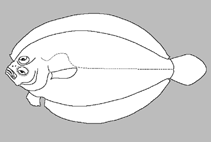
>
Pleuronectiformes (Flatfishes) >
Bothidae (Lefteye flounders)
Etymology: Arnoglossus: Greek, aros, -oy = lamb + Greek, glossa = tongue (Ref. 45335).
Eponymy: Philip Armstrong – about whom we know nothing other than the etymology’s statement that the holotype was caught at Bridport, northern Tasmania “…by Mr Philip Armstrong, in whose honour the species is named.” (Ref. 128868), visit book page.
Ambiente: milieu / zona climatica / distribuzione batimetrica / gamma di distribuzione
Ecologia
marino demersale. Temperate
Eastern Indian Ocean: Tasmania, Australia.
Dimensione / Peso / Età
Maturità: Lm ? range ? - ? cm
Max length : 16.9 cm SL maschio/sesso non determinato; (Ref. 13746)
Ciclo vitale e comportamento di accoppiamento
Maturità | Riproduzione | Deposizione | Uova | Fecondità | Larve
Amaoka, K., M. Arai and M. Gomon, 1997. A new species of Arnoglossus (Pleuronectiformes: Bothidae) from the southwestern coast of Australia. Ichthyol. Res. 44(2):131-136. (Ref. 13746)
Stato della Lista Rossa IUCN (Ref. 130435: Version 2025-2 (Global))
Minaccia per l'uomo
Harmless
Usi umani
Strumenti
Rapporti speciali
Scarica XML
Fonti Internet
Stime basate su modelli
Indice di diversità filogenetica (Fonte Biblio.
82804): PD
50 = 0.5000 [Uniqueness, from 0.5 = low to 2.0 = high].
Bayesian length-weight: a=0.00912 (0.00412 - 0.02018), b=3.05 (2.87 - 3.23), in cm total length, based on LWR estimates for this (Sub)family-body shape (Ref.
93245).
Livello trofico (Fonte Biblio.
69278): 3.6 ±0.4 se; based on size and trophs of closest relatives
Resilienza (Fonte Biblio.
120179): Medio, tempo minimo di raddoppiamento della popolazione 1.4 - 4.4 anni (Preliminary K or Fecundity.).
Vulnerabilità della pesca (Ref.
59153): Low vulnerability (11 of 100).
🛈