Ελασμοβράγχιοι (καρχαρίες και σαλάχια) (sharks and rays) >
Carcharhiniformes (Ground sharks) >
Triakidae (Houndsharks) > Triakinae
Etymology: Mustelus: Latin for weasel, an ancient name for sharks, possibly referring to the pointed snouts, swift movements and/or rapacious feeding behavior of smaller predatory sharks [strictly not tautonymous with Squalus mustelus Linnaeus 1758 since type was designated by the ICZN] (See ETYFish); mosis: Etymology not explained (no written description); since mosis is the Latin spelling of Moses, possibly an allusion to this shark’s type locality in the Red Sea (See ETYFish).
More on authors: Hemprich & Ehrenberg.
Περιβάλλον: περιβάλλον / κλιματική ζώνη / εύρος βάθους / εύρος διανομής
Οικολογία
Θαλασσινό(ά) βενθικό(ς); εύρος βάθους ? - 400 m (Ref. 100719). Tropical; 30°N - 7°N
Indian Ocean: Red Sea, Arabian Sea and the Persian Gulf, southernmost confirmed records from off Somalia in the Gulf of Aden.
Μήκος κατά την πρώτη ωρίμανση / Μέγεθος / Βάρος / Ηλικία
Γεννητική Ωρίμανση: Lm 67.5, range 62 - 80 cm
Max length : 150 cm TL αρσενικό/απροσδιόριστο; (Ref. 244)
Σύντομη περιγραφή
Κλείδες προσδιορισμού | Μορφολογία | Μορφομετρία
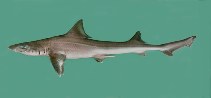
Ραχιαίες άκανθες (συνολικά) : 0; Εδρικές άκανθες: 0. A smoothhound without spots and often with a white-tipped 1st dorsal fin; adults with a hard, bone-like growth embedded in snout, readily felt by pinching it (Ref. 5578). Grey or grey-brown dorsally, white ventrally (Ref. 5578). Pectoral fins with pale trailing edges (Ref. 5485).
Body shape (shape guide): elongated.
Occurs in continental waters, both inshore and offshore (Ref. 244). Sometimes seen on coral reefs (Ref. 244). Feeds on small bottom fishes, mollusks, and crustaceans (Ref. 244). In the Gulf of Aqaba on cephalopods, decapods and terrestrial food items while off Al-Ghardaqar near the entrance of the Gulf of Suez, prawns, small crabs and small fish were found in the specimens (Ref. 124465). Viviparous (Ref. 244). Caught by shore anglers (Ref. 5578). Readily lives in captivity (Ref. 244). Utilized as a foodfish (Ref. 244).
Viviparous, with 6 to 10 young in a litter; born at 26-28 cm (Ref. 5485). Distinct pairing with embrace (Ref. 205).
White, W.T., S. Arunrugstichai and G.J.P. Naylor, 2021. Revision of the genus Mustelus (Carcharhiniformes: Triakidae) in the northern Indian Ocean, with description of a new species and a discussion on the validity of M. walkeri and M. ravidus. Mar. Biodiversity 51(42):1-24. (Ref. 124465)
Κατάσταση Κόκκινου Καταλόγου IUCN (Ref. 130435: Version 2025-2 (Global))
Απειλή για τον άνθρωπο
Harmless
Ανθρώπινες χρήσεις
αλιεία: Εμπορικό(ά); αλιεία αναψυχής: ναί
Εργαλεία
Ειδικές εκθέσεις
Λήψη XML
Διαδικτυακές πηγές
Εκτιμήσεις βάσει μοντέλων
Δείκτης φυλογενετικής ποικιλότητας (Αναφ.
82804): PD
50 = 0.5000 [Uniqueness, from 0.5 = low to 2.0 = high].
Bayesian length-weight: a=0.00229 (0.00107 - 0.00491), b=3.14 (2.97 - 3.31), in cm total length, based on LWR estimates for this Genus-body shape (Ref.
93245).
Τροφικό Επίπεδο (Αναφ.
69278): 4.0 ±0.52 se; based on food items.
Ελαστικότητα (Αναφ.
120179): Πολύ χαμηλό, ελάχιστος χρόνος για διπλασιασμό πληθυσμού > 14 έτη (Fec=4).
Ευπάθεια στην αλιεία (Ref.
59153): Very high vulnerability (90 of 100).
🛈