Élasmobranches (requins et raies) (sharks and rays) >
Carcharhiniformes (Ground sharks) >
Triakidae (Houndsharks) > Triakinae
Etymology: Mustelus: Latin for weasel, an ancient name for sharks, possibly referring to the pointed snouts, swift movements and/or rapacious feeding behavior of smaller predatory sharks [strictly not tautonymous with Squalus mustelus Linnaeus 1758 since type was designated by the ICZN] (See ETYFish); mosis: Etymology not explained (no written description); since mosis is the Latin spelling of Moses, possibly an allusion to this shark’s type locality in the Red Sea (See ETYFish).
More on authors: Hemprich & Ehrenberg.
Environnement : milieu / zone climatique / profondeur / gamme de distribution
Écologie
marin démersal; profondeur ? - 400 m (Ref. 100719). Tropical; 30°N - 7°N
Indian Ocean: Red Sea, Arabian Sea and the Persian Gulf, southernmost confirmed records from off Somalia in the Gulf of Aden.
Longueur à la première maturité / Taille / Poids / Âge
Maturité: Lm 67.5, range 62 - 80 cm
Max length : 150 cm TL mâle / non sexé; (Ref. 244)
Description synthétique
Clés d'identification | Morphologie | Morphométrie
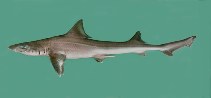
Épines dorsales (Total) : 0; Épines anales: 0. A smoothhound without spots and often with a white-tipped 1st dorsal fin; adults with a hard, bone-like growth embedded in snout, readily felt by pinching it (Ref. 5578). Grey or grey-brown dorsally, white ventrally (Ref. 5578). Pectoral fins with pale trailing edges (Ref. 5485).
Body shape (shape guide): elongated.
Occurs in continental waters, both inshore and offshore (Ref. 244). Sometimes seen on coral reefs (Ref. 244). Feeds on small bottom fishes, mollusks, and crustaceans (Ref. 244). In the Gulf of Aqaba on cephalopods, decapods and terrestrial food items while off Al-Ghardaqar near the entrance of the Gulf of Suez, prawns, small crabs and small fish were found in the specimens (Ref. 124465). Viviparous (Ref. 244). Caught by shore anglers (Ref. 5578). Readily lives in captivity (Ref. 244). Utilized as a foodfish (Ref. 244).
Cycle de vie et comportement reproducteur
Maturité | Reproduction | Frai | Œufs | Fécondité | Larves
Viviparous, with 6 to 10 young in a litter; born at 26-28 cm (Ref. 5485). Distinct pairing with embrace (Ref. 205).
White, W.T., S. Arunrugstichai and G.J.P. Naylor, 2021. Revision of the genus Mustelus (Carcharhiniformes: Triakidae) in the northern Indian Ocean, with description of a new species and a discussion on the validity of M. walkeri and M. ravidus. Mar. Biodiversity 51(42):1-24. (Ref. 124465)
Statut dans la liste rouge de l'IUCN (Ref. 130435: Version 2025-2 (Global))
Menace pour l'homme
Harmless
Utilisations par l'homme
Pêcheries: commercial; pêche sportive: oui
Outils
Articles particuliers
Télécharger en XML
Sources Internet
Estimations basées sur des modèles
Indice de diversité phylogénétique (Réf.
82804): PD
50 = 0.5000 [Uniqueness, from 0.5 = low to 2.0 = high].
Bayesian length-weight: a=0.00229 (0.00107 - 0.00491), b=3.14 (2.97 - 3.31), in cm total length, based on LWR estimates for this Genus-body shape (Ref.
93245).
Niveau trophique (Réf.
69278): 4.0 ±0.52 se; based on food items.
Résilience (Réf.
120179): Très faible, temps minimum de doublement de population supérieur à 14 ans (Fec=4).
Vulnérabilité de la pêche (Ref.
59153): Very high vulnerability (90 of 100).
🛈