Elasmobranquios (tiburones y rayas) (sharks and rays) >
Carcharhiniformes (Ground sharks) >
Triakidae (Houndsharks) > Triakinae
Etymology: Mustelus: Latin for weasel, an ancient name for sharks, possibly referring to the pointed snouts, swift movements and/or rapacious feeding behavior of smaller predatory sharks [strictly not tautonymous with Squalus mustelus Linnaeus 1758 since type was designated by the ICZN] (See ETYFish); palumbes: Latin for wood-pigeon or ring-dove, referring to its dove-gray coloration (See ETYFish).
More on author: Smith.
Entorno: milieu / zona climática / rango de profundidad / gama de distribución
Ecología
marino demersal; rango de profundidad 0 - 443 m (Ref. 5578). Subtropical; 17°S - 36°S
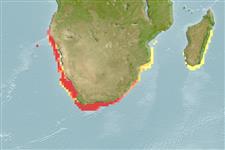
Southeast Atlantic: Namibia to central Natal, South Africa.
Tamaño / Peso / Edad
Madurez: Lm ? range ? - ? cm
Max length : 120 cm TL macho / no sexado; (Ref. 244)
Descripción breve
Claves de identificación | Morfología | Morfometría
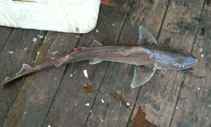
Espinas dorsales (total) : 0; Espinas anales: 0. A smoothhound with lines or scatterings of small white spots along body (Ref. 5578). Grey above, white below (Ref. 5578).
Body shape (shape guide): elongated.
Found on the continental shelf and upper slope from the intertidal region to deeper waters over sand and gravel bottoms (Ref. 244). Feeds on crustaceans, octopi, bony fish, and fish offal (Ref. 5578). Ovoviviparous (Ref. 50449). Catch usually discarded but may be utilized in a local fishery that processes sharks into jerky (Ref. 244).
Ciclo vital y comportamiento de apareamiento
Madurez | Reproducción | Puesta | Huevos | Fecundidad | Larva
Ovoviviparous, embryos feed solely on yolk (Ref. 50449). 3 to 8 young per litter. Born at around 25 cm. (Ref. 5485). Distinct pairing with embrace (Ref. 205).
Compagno, L.J.V., 1984. FAO Species Catalogue. Vol. 4. Sharks of the world. An annotated and illustrated catalogue of shark species known to date. Part 2 - Carcharhiniformes. FAO Fish. Synop. 125(4/2):251-655. Rome: FAO. (Ref. 244)
Situación en la Lista Roja de la UICN (Ref. 130435: Version 2025-2 (Global))
Amenaza para el ser humano
Harmless
Usos humanos
Pesquerías: escaso valor comercial; pesca deportiva: si
Herramientas
Informes especiales
Descargar XML
Fuentes de Internet
Estimaciones basadas en modelos
Temperatura preferida (Referencia
123201): 10.2 - 18, mean 12.8 °C (based on 80 cells).
Índice de diversidad filogenética (Referencia
82804): PD
50 = 0.5000 [Uniqueness, from 0.5 = low to 2.0 = high].
Bayesian length-weight: a=0.00229 (0.00107 - 0.00491), b=3.14 (2.97 - 3.31), in cm total length, based on LWR estimates for this Genus-body shape (Ref.
93245).
Nivel trófico (Referencia
69278): 3.5 ±0.5 se; based on diet studies.
Resiliencia (Referencia
120179): Muy bajo, población duplicada en un tiempo mínimo superior a 14 años (Fec=4).
Vulnerabilidad pesquera (Ref.
59153): High to very high vulnerability (72 of 100).
🛈
Nutrientes (Ref.
124155): Calcium = 16.9 [4.9, 85.4] mg/100g; Iron = 0.471 [0.151, 1.782] mg/100g; Protein = 21.6 [19.3, 23.8] %; Omega3 = 0.144 [0.059, 0.331] g/100g; Selenium = 47.4 [14.1, 169.2] μg/100g; VitaminA = 6.61 [2.26, 18.61] μg/100g; Zinc = 0.615 [0.270, 1.252] mg/100g (wet weight);