Elasmobranchii (tubarões e raias) (sharks and rays) >
Carcharhiniformes (Ground sharks) >
Triakidae (Houndsharks) > Triakinae
Etymology: Mustelus: Latin for weasel, an ancient name for sharks, possibly referring to the pointed snouts, swift movements and/or rapacious feeding behavior of smaller predatory sharks [strictly not tautonymous with Squalus mustelus Linnaeus 1758 since type was designated by the ICZN] (See ETYFish); palumbes: Latin for wood-pigeon or ring-dove, referring to its dove-gray coloration (See ETYFish).
More on author: Smith.
Ambiente: milieu / zona climática / intervalo de profundidade / gama de distribuição
Ecologia
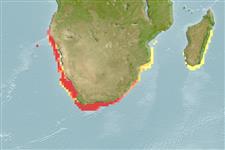
marinhas demersal; intervalo de profundidade 0 - 443 m (Ref. 5578). Subtropical; 17°S - 36°S
Southeast Atlantic: Namibia to central Natal, South Africa.
Tamanho / Peso / Idade
Maturidade: Lm ? range ? - ? cm
Max length : 120 cm TL macho/indeterminado; (Ref. 244)
Descrição breve
Chaves de identificação | Morfologia | Morfometria
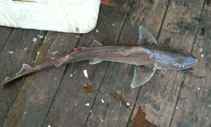
Espinhos dorsais (total) : 0; Espinhos anais: 0. A smoothhound with lines or scatterings of small white spots along body (Ref. 5578). Grey above, white below (Ref. 5578).
Body shape (shape guide): elongated.
Found on the continental shelf and upper slope from the intertidal region to deeper waters over sand and gravel bottoms (Ref. 244). Feeds on crustaceans, octopi, bony fish, and fish offal (Ref. 5578). Ovoviviparous (Ref. 50449). Catch usually discarded but may be utilized in a local fishery that processes sharks into jerky (Ref. 244).
Ciclo de vida e comportamento de acasalamento
Maturidade | Reprodução | Desova | Ovos | Fecundidade | Larvas
Ovoviviparous, embryos feed solely on yolk (Ref. 50449). 3 to 8 young per litter. Born at around 25 cm. (Ref. 5485). Distinct pairing with embrace (Ref. 205).
Compagno, L.J.V., 1984. FAO Species Catalogue. Vol. 4. Sharks of the world. An annotated and illustrated catalogue of shark species known to date. Part 2 - Carcharhiniformes. FAO Fish. Synop. 125(4/2):251-655. Rome: FAO. (Ref. 244)
Categoria na Lista Vermelha da IUCN (Ref. 130435: Version 2025-2 (Global))
Ameaça para o homem
Harmless
Utilização humana
Pescarias: pouco comercial; peixe desportivo: sim
Ferramentas
Relatórios especiais
Descarregue XML
Fontes da internet
Estimativas baseadas em modelos
Temperatura preferida (Ref.
123201): 10.2 - 18, mean 12.8 °C (based on 80 cells).
Índice de diversidade filogenética (Ref.
82804): PD
50 = 0.5000 [Uniqueness, from 0.5 = low to 2.0 = high].
Bayesian length-weight: a=0.00229 (0.00107 - 0.00491), b=3.14 (2.97 - 3.31), in cm total length, based on LWR estimates for this Genus-body shape (Ref.
93245).
Nível Trófico (Ref.
69278): 3.5 ±0.5 se; based on diet studies.
Resiliência (Ref.
120179): Muito baixo, tempo mínimo de duplicação da população maior que 14 anos (Fec=4).
Vulnerabilidade da pesca (Ref.
59153): High to very high vulnerability (72 of 100).
🛈
Nutrientes (Ref.
124155): Calcium = 16.9 [4.9, 85.4] mg/100g; Iron = 0.471 [0.151, 1.782] mg/100g; Protein = 21.6 [19.3, 23.8] %; Omega3 = 0.144 [0.059, 0.331] g/100g; Selenium = 47.4 [14.1, 169.2] μg/100g; VitaminA = 6.61 [2.26, 18.61] μg/100g; Zinc = 0.615 [0.270, 1.252] mg/100g (wet weight);