>
Anguilliformes (Eels and morays) >
Congridae (Conger and garden eels) > Heterocongrinae
Etymology: Heteroconger: Greek, heteros = other + Latin, conger = conger (Ref. 45335).
Eponymy: Dr James Wittenmyer Chapman (1880–1964) was an American Presbyterian missionary and myrmecologist. [...] (Ref. 128868), visit book page.
More on author: Herre.
Meio ambiente: milieu / Zona climática / intervalo de profundidade / faixa de distribuição
Ecologia
marinhas demersal. Tropical
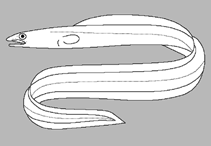
Western Central Pacific: Philippines. Because Herre's description of Heteroconger chapmani was not detailed enough to confidently refer the species to any garden eel known today and because the holotype and only specimen was destroyed in Manila during World War II, Castle and Randall (1999) regard this species as unidentifiable (Ref. 33408).
Tamanho / Peso / Idade
Maturidade: Lm ? range ? - ? cm
Max length : 69.0 cm TL macho/indeterminado; (Ref. 33408)
Descrição suscinta
Chaves de identificação | Morfologia | Morfometria
Ciclo de vida ou comportamento de acasalamento
Maturidade | Reprodução | Desova | Ovos | Fecundidade | Larvas
Smith, D.G., 1999. Congridae. Conger eels. p. 1680-1686. In K.E. Carpenter and V.H. Niem (eds.) FAO species identification guide for fishery purposes. The living marine resources of the WCP. Vol. 3. Batoid fishes, chimaeras and bony fishes part 1 (Elopidae to Linophrynidae). FAO, Rome. (Ref. 11039)
Status na Lista Vermelha da UICN (Ref. 130435: Version 2025-2 (Global))
Ameaça para os humanos
Harmless
Uso pelos humanos
Ferramentas
Relatórios especiais
Baixar XML
Fontes da internet
Estimativas baseadas em modelos
Índice de diversidade filogenética (Ref.
82804): PD
50 = 0.5000 [Uniqueness, from 0.5 = low to 2.0 = high].
Bayesian length-weight: a=0.00102 (0.00046 - 0.00225), b=3.06 (2.88 - 3.24), in cm total length, based on all LWR estimates for this body shape (Ref.
93245).
Nível Trófico (Ref.
69278): 3.4 ±0.4 se; based on size and trophs of closest relatives
Resiliência (Ref.
120179): médio(a), tempo mínimo de duplicação da população 1,4 - 4,4 anos (Preliminary K or Fecundity.).
Vulnerabilidade da pesca (Ref.
59153): Moderate to high vulnerability (48 of 100).
🛈