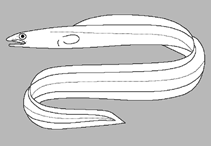
>
Anguilliformes (Eels and morays) >
Congridae (Conger and garden eels) > Heterocongrinae
Etymology: Heteroconger: Greek, heteros = other + Latin, conger = conger (Ref. 45335).
Eponymy: Dr James Wittenmyer Chapman (1880–1964) was an American Presbyterian missionary and myrmecologist. [...] (Ref. 128868), visit book page.
More on author: Herre.
Ambiente: milieu / zona climatica / distribuzione batimetrica / gamma di distribuzione
Ecologia
marino demersale. Tropical
Western Central Pacific: Philippines. Because Herre's description of Heteroconger chapmani was not detailed enough to confidently refer the species to any garden eel known today and because the holotype and only specimen was destroyed in Manila during World War II, Castle and Randall (1999) regard this species as unidentifiable (Ref. 33408).
Dimensione / Peso / Età
Maturità: Lm ? range ? - ? cm
Max length : 69.0 cm TL maschio/sesso non determinato; (Ref. 33408)
Breve descrizione
Chiavi di identificazione | Morfologia | Morfometria
Ciclo vitale e comportamento di accoppiamento
Maturità | Riproduzione | Deposizione | Uova | Fecondità | Larve
Smith, D.G., 1999. Congridae. Conger eels. p. 1680-1686. In K.E. Carpenter and V.H. Niem (eds.) FAO species identification guide for fishery purposes. The living marine resources of the WCP. Vol. 3. Batoid fishes, chimaeras and bony fishes part 1 (Elopidae to Linophrynidae). FAO, Rome. (Ref. 11039)
Stato della Lista Rossa IUCN (Ref. 130435: Version 2025-2 (Global))
Minaccia per l'uomo
Harmless
Usi umani
Strumenti
Rapporti speciali
Scarica XML
Fonti Internet
Stime basate su modelli
Indice di diversità filogenetica (Fonte Biblio.
82804): PD
50 = 0.5000 [Uniqueness, from 0.5 = low to 2.0 = high].
Bayesian length-weight: a=0.00102 (0.00046 - 0.00225), b=3.06 (2.88 - 3.24), in cm total length, based on all LWR estimates for this body shape (Ref.
93245).
Livello trofico (Fonte Biblio.
69278): 3.4 ±0.4 se; based on size and trophs of closest relatives
Resilienza (Fonte Biblio.
120179): Medio, tempo minimo di raddoppiamento della popolazione 1.4 - 4.4 anni (Preliminary K or Fecundity.).
Vulnerabilità della pesca (Ref.
59153): Moderate to high vulnerability (48 of 100).
🛈