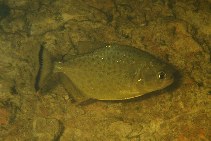
>
Characiformes (Characins) >
Serrasalmidae (Piranhas and pacus) > Serrasalminae
Etymology: Serrasalmus: Latin, serran, serranus, saw and a fish of genus Serranus + Latin, salmo = salmon (Ref. 45335).
More on author: Kner.
Taxonomic Remarks
Eschmeyer (1998: 994) syntype designation of BMNH 1928.1.24:10 Myletes maculatus Kner 1858 currently placed under Metynnis, is erroneous. Recent (10 Feb. 1978) and local syntype designations of NMW 57058 collected from Rio Negro, Brazil are erroneous. See Jégu & Santos (2001) for detailed morphology and distribution. See Martins-Santos, Julio-Jr. & Santos (1994) and Nakayama, Porto & Feldberg (2000) for cytogenetic study.
Environnement : milieu / zone climatique / profondeur / gamme de distribution
Écologie
; eau douce pélagique. Tropical
South America: Amazon and Paraguay-Paraná River basins (Ref. 39031). Recorded from the Uruguay River (Ref. 79585).
Longueur à la première maturité / Taille / Poids / Âge
Maturité: Lm 10.8 range ? - ? cm
Max length : 26.4 cm TL mâle / non sexé; (Ref. 115169); 34.5 cm TL (female); poids max. publié: 420.00 g (Ref. 115169); poids max. publié: 420.00 g
Description synthétique
Clés d'identification | Morphologie | Morphométrie
Rayons mous dorsaux (Total) : 16; Rayons mous anaux: 33 - 35; Vertèbres: 36.
Body shape (shape guide): short and / or deep; Cross section: compressed.
Occurs usually in small groups of up to 20 individuals which appear to have a definite range within a pond or a creek. Observed to be active mainly during the day. Larger fish extend their foraging until about 9 at night. where it stays in the shallows near the bottom, sheltered among vegetation (Ref. 9080). Larvae and juveniles hide and feed within the root tangle of water hyacinths, which also act as a dispersal agent during floods (Ref. 40399). Larvae feed on
microscopic crustaceans and small aquatic insects; very small size juveniles (about 1.2 cm)
already clip fins of other fishes (Ref. 40399). Juveniles and adults feed mostly on fins and muscle portions of fishes (Ref. 9080, 40398). Adults may scavenge on dead mammals, including humans (Ref. 40400). Attacks on humans with bite outbreaks may occur in dammed
portions of rivers during the breeding season, related to brood protection by the spawning
adults (Ref. 50802).
Cycle de vie et comportement reproducteur
Maturité | Reproduction | Frai | Œufs | Fécondité | Larves
Jégu, M., 2003. Serrasalminae (Pacus and piranhas). p. 182-196. In R.E. Reis, S.O. Kullander and C.J. Ferraris, Jr. (eds.) Checklist of the Freshwater Fishes of South and Central America. Porto Alegre: EDIPUCRS, Brasil. (Ref. 39031)
Statut dans la liste rouge de l'IUCN (Ref. 130435: Version 2025-2 (Global))
Menace pour l'homme
Traumatogenic (Ref. 50802)
Utilisations par l'homme
Outils
Articles particuliers
Télécharger en XML
Sources Internet
Estimations basées sur des modèles
Indice de diversité phylogénétique (Réf.
82804): PD
50 = 0.5000 [Uniqueness, from 0.5 = low to 2.0 = high].
Bayesian length-weight: a=0.01585 (0.01313 - 0.01913), b=3.17 (3.13 - 3.21), in cm total length, based on LWR estimates for this species (Ref.
93245).
Niveau trophique (Réf.
69278): 4.1 ±0.71 se; based on food items.
Résilience (Réf.
120179): Haut, temps minimum de doublement de population inférieur à 15 mois (Preliminary K or Fecundity.).
Vulnérabilité de la pêche (Ref.
59153): Low vulnerability (25 of 100).
🛈