>
Eupercaria/misc (Various families in series Eupercaria) >
Priacanthidae (Bigeyes or catalufas)
Etymology: Priacanthus: Greek, prion = saw + Greek, akantha = thorn (Ref. 45335).
पर्यावरण: पर्यावरण / जलवायु क्षेत्र / गहराई सीमा / वितरण सीमा
पारिस्थितिकी
समुद्री प्रवाल-भित्ति संयुक्त; गहराई सीमा 0 - 250 m (Ref. 9710). Tropical; 36°N - 36°S, 24°E - 109°W
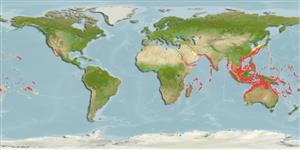
Indo-Pacific: Red Sea and southern Africa to French Polynesia, north to southern Japan, south to Australia. Reported from Easter Island (Ref. 33390).
प्रथम परिपक्वता पर लंबाई / आकार / वज़न / आयु
परिपक्व अवधि: Lm 22.0 range ? - ? cm
Max length : 45.0 cm TL पुल्लिंग / अलिंग; (Ref. 4328); common length : 40.0 cm TL पुल्लिंग / अलिंग; (Ref. 5450)
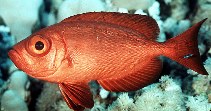
पृष्ठीय रीढ़ (सम्पूर्ण) : 10; पृष्ठीय सौफट रेज़ (सम्पूर्ण) : 13 - 15; गुदा कांटा: 3; ऐनल सौफट रेज़: 13 - 16. This species is distinguished by the following characters: body depth 2.5-2.9 in SL; poorly developed preopercular spine, reduced or inconspicuous to non-existent in adults (> 12.5 cm TL); total gill rakers in first gill arch 24-26; soft portion of dorsal fin taller than spinous portion, angular posteriorly; pectoral fins shorter than pelvic spine; pelvic fins long, reaching posterior to spinous portion of anal fin; distinctly emarginate caudal fin; scales modified, the posterior field elevated as a separate flange with spinules both on surface and posterior margin; vertical scale rows (dorsal-fin origin to anus) 48-57; swimbladder with pair of anterior and posterior protrusions. Colour of body entirely red or capable of quickly changing to silvery with about 6 red bars or large spots on upper side (dusky spots evident on dorsal and anal fin in blotchy or barred fish); membranes of caudal and pelvic fins blackish distally (Ref. 54980, 68288, 90102).
Body shape (shape guide): short and / or deep; Cross section: compressed.
Uncommon species found in outer reef slopes and deep lagoon pinnacles from 8 to at least 80 m. In small aggregations, sometimes schools in oceanic locations (Ref. 48635). Also found under ledges or hovering next to coral heads during day (Ref 90102). Feeds on small fish, crustaceans, and other small invertebrates (Ref. 5213). Occasionally taken in moderate numbers in trawls and by hook-and-line (Ref. 68288). Generally marketed fresh, may be salted or dried (Ref. 5284). Minimum depth reported taken from Ref. 128797.
Starnes, W.C., 1988. Revision, phylogeny and biogeographic comments on the circumtropical marine percoid fish family Priacanthidae. Bull. Mar. Sci. 43(2):117-203. (Ref. 5403)
आईयूसीएन रेड लिस्ट स्थिति (Ref. 130435: Version 2025-2 (Global))
मनुष्यों के लिए ख़तरा
Harmless
मानव उपयोग
मात्स्यिकी: लघु वाणिज्य; जलजीवालय: व्यापारिक
साधन
विशेष रिपोर्ट
XML डाउनलोड करें
इंटरनेट स्रोत
मॉडल पर आधारित अनुमान
पसंदीदा तापमान (संदर्भ
123201): 19.1 - 28.2, mean 26.2 °C (based on 1065 cells).
जातिवृति विविधता सूचकांक (संदर्भ
82804): PD
50 = 0.5001 [Uniqueness, from 0.5 = low to 2.0 = high].
Bayesian length-weight: a=0.01778 (0.01245 - 0.02540), b=2.88 (2.78 - 2.98), in cm total length, based on LWR estimates for this species (Ref.
93245).
ट्रॉफिक स्तर (संदर्भ
69278): 3.6 ±0.5 se; based on diet studies.
लौटाव (संदर्भ
120179): ऊंचा, न्यूनतम जनसंख्या दुगनी समय अवलागत 15 महीने। (K=0.5-0.7; Fec=13,133).
मछली पकड़ने की भेद्यता (Ref.
59153): Low vulnerability (24 of 100).
🛈
पोषक तत्व (Ref.
124155): Calcium = 46.8 [23.1, 75.7] mg/100g; Iron = 0.608 [0.355, 0.985] mg/100g; Protein = 18.9 [17.7, 20.0] %; Omega3 = 0.129 [0.079, 0.216] g/100g; Selenium = 55 [31, 104] μg/100g; VitaminA = 32.6 [9.2, 114.0] μg/100g; Zinc = 0.879 [0.600, 1.277] mg/100g (wet weight);