>
Eupercaria/misc (Various families in series Eupercaria) >
Labridae (Wrasses) > Julidinae
Etymology: Stethojulis: Greek, stetho, stethion = brest; literal = to prick a little breast + Greek, ioulis, a fish dealing with genera Coris or Thalassoma (Ref. 45335).
More on author: Bleeker.
Environnement : milieu / zone climatique / profondeur / gamme de distribution
Écologie
marin récifal; profondeur 0 - 30 m (Ref. 9311). Tropical; 32°N - 32°S, 92°E - 89°W
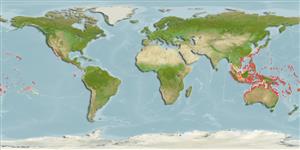
Indo-Pacific: eastern Indian Ocean to western Australia, including the Christmas Island, Cocos-Keeling and the Andaman Sea; then from Japan to New South Wales, Australia. Eastern Pacific: offshore islands in the eastern Pacific, including Clipperton, Cocos and the Galapagos islands (Ref. 36378). Range extends to Baja California during El Niño (Victor, pers. comm.). Replaced by Stethojulis albovittata in the western Indian Ocean and Stethojulis balteata in the Hawaiian Islands (Ref. 37816).
Taille / Poids / Âge
Maturité: Lm ? range ? - ? cm
Max length : 15.0 cm TL mâle / non sexé; (Ref. 30874); 8.0 cm TL (female)
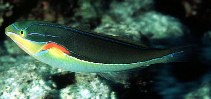
Épines dorsales (Total) : 9; Rayons mous dorsaux (Total) : 11 - 12; Épines anales: 3; Rayons mous anaux: 11. 1st spine of the anal fin is minute or imbedded (Ref. 1602).Terminal males typically have a series of partial to complete longitudinal thin blue lines on their sides (Ref. 1602). Females mainly bluish grey with fine white spotting over upper sides and a small red spot at axil of pectoral fin (Ref. 48636).
Body shape (shape guide): fusiform / normal; Cross section: compressed.
Usually found in shallow clear water of reef flats and lagoon and seaward reefs, in areas of mixed sand, rubble and coral (Ref. 9710, 58534). Usually solitary or in small groups (Ref. 9311). Feeds mainly on demersal planktonic crustaceans and small benthic invertebrates. Female length is from Ref. 9137. Replaced by S. albovittatus in the Andaman Sea (Ref. 90102). Minimum depth reported taken from Ref. 128797.
Cycle de vie et comportement reproducteur
Maturité | Reproduction | Frai | Œufs | Fécondité | Larves
Oviparous, distinct pairing during breeding (Ref. 205).
Randall, J.E., 2000. Revision of the Indo-Pacific labrid fishes of the genus Stethojulis, with descriptions of two new species. Indo-Pac. Fish. (31):42 p. (Ref. 36378)
Statut dans la liste rouge de l'IUCN (Ref. 130435: Version 2025-2 (Global))
Menace pour l'homme
Harmless
Utilisations par l'homme
Pêcheries: intérêt commercial mineur; Aquarium: Commercial
Outils
Articles particuliers
Télécharger en XML
Sources Internet
Estimations basées sur des modèles
Température préférée (Réf.
123201): 24.5 - 29.3, mean 28.4 °C (based on 2292 cells).
Indice de diversité phylogénétique (Réf.
82804): PD
50 = 0.5010 [Uniqueness, from 0.5 = low to 2.0 = high].
Bayesian length-weight: a=0.01000 (0.00566 - 0.01766), b=3.00 (2.85 - 3.15), in cm total length, based on LWR estimates for this species & Genus-body shape (Ref.
93245).
Niveau trophique (Réf.
69278): 3.2 ±0.2 se; based on diet studies.
Résilience (Réf.
120179): Haut, temps minimum de doublement de population inférieur à 15 mois (Preliminary K or Fecundity.).
Vulnérabilité de la pêche (Ref.
59153): Low vulnerability (10 of 100).
🛈
Nutriments (Ref.
124155): Calcium = 90.1 [53.3, 149.7] mg/100g; Iron = 0.741 [0.435, 1.371] mg/100g; Protein = 18.4 [15.5, 20.5] %; Omega3 = 0.152 [0.098, 0.236] g/100g; Selenium = 24 [15, 42] μg/100g; VitaminA = 137 [43, 504] μg/100g; Zinc = 1.82 [1.27, 2.91] mg/100g (wet weight);