>
Eupercaria/misc (Various families in series Eupercaria) >
Labridae (Wrasses) > Julidinae
Etymology: Stethojulis: Greek, stetho, stethion = brest; literal = to prick a little breast + Greek, ioulis, a fish dealing with genera Coris or Thalassoma (Ref. 45335).
More on author: Bleeker.
Milieu: milieu / Klimaatzone / Diepte / verspreidingsgebied
Ecologie
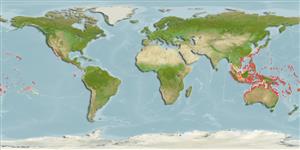
marien rifbewoner; diepte 0 - 30 m (Ref. 9311). Tropical; 32°N - 32°S, 92°E - 89°W
Indo-Pacific: eastern Indian Ocean to western Australia, including the Christmas Island, Cocos-Keeling and the Andaman Sea; then from Japan to New South Wales, Australia. Eastern Pacific: offshore islands in the eastern Pacific, including Clipperton, Cocos and the Galapagos islands (Ref. 36378). Range extends to Baja California during El Niño (Victor, pers. comm.). Replaced by Stethojulis albovittata in the western Indian Ocean and Stethojulis balteata in the Hawaiian Islands (Ref. 37816).
Grootte / Gewicht / Leeftijd
Maturiteit: Lm ? range ? - ? cm
Max length : 15.0 cm TL mannelijk / geslacht onbekend; (Ref. 30874); 8.0 cm TL (female)
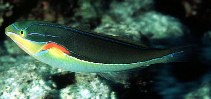
Dorsale stekels (totaal) : 9; Dorsale zachte stralen (totaal) : 11 - 12; Anale stekels: 3; Anale zachte stralen: 11. 1st spine of the anal fin is minute or imbedded (Ref. 1602).Terminal males typically have a series of partial to complete longitudinal thin blue lines on their sides (Ref. 1602). Females mainly bluish grey with fine white spotting over upper sides and a small red spot at axil of pectoral fin (Ref. 48636).
Body shape (shape guide): fusiform / normal; Cross section: compressed.
Usually found in shallow clear water of reef flats and lagoon and seaward reefs, in areas of mixed sand, rubble and coral (Ref. 9710, 58534). Usually solitary or in small groups (Ref. 9311). Feeds mainly on demersal planktonic crustaceans and small benthic invertebrates. Female length is from Ref. 9137. Replaced by S. albovittatus in the Andaman Sea (Ref. 90102). Minimum depth reported taken from Ref. 128797.
Levenscyclus en paargedrag
Maturiteit | Voortplanting | Paaien | Eieren | Fecunditeit | Larven
Oviparous, distinct pairing during breeding (Ref. 205).
Randall, J.E., 2000. Revision of the Indo-Pacific labrid fishes of the genus Stethojulis, with descriptions of two new species. Indo-Pac. Fish. (31):42 p. (Ref. 36378)
Status op de Rode Lijst van het IUCN (Ref. 130435: Version 2025-2 (Global))
Gevaar voor de mens
Harmless
Gebruik door de mens
Visserij: van minder commercieel belang; Aquarium: Commercieel
Tools
Speciale rapporten
Download XML
Internetbronnen
Schattingen op basis van modellen
Gewenste temperatuur (Ref.
123201): 24.5 - 29.3, mean 28.4 °C (based on 2292 cells).
Fylogenetische diversiteitsindex (Ref.
82804): PD
50 = 0.5010 [Uniqueness, from 0.5 = low to 2.0 = high].
Bayesian length-weight: a=0.01000 (0.00566 - 0.01766), b=3.00 (2.85 - 3.15), in cm total length, based on LWR estimates for this species & Genus-body shape (Ref.
93245).
Trofisch niveau (Ref.
69278): 3.2 ±0.2 se; based on diet studies.
Weerstandsvermogen (Ref.
120179): Hoog, minimale populatieverdubbelingstijd minder dan 15 maanden (Preliminary K or Fecundity.).
Kwetsbaarheid van de visserij (Ref.
59153): Low vulnerability (10 of 100).
🛈
Voedingsstoffen (Ref.
124155): Calcium = 90.1 [53.3, 149.7] mg/100g; Iron = 0.741 [0.435, 1.371] mg/100g; Protein = 18.4 [15.5, 20.5] %; Omega3 = 0.152 [0.098, 0.236] g/100g; Selenium = 24 [15, 42] μg/100g; VitaminA = 137 [43, 504] μg/100g; Zinc = 1.82 [1.27, 2.91] mg/100g (wet weight);