>
Eupercaria/misc (Various families in series Eupercaria) >
Labridae (Wrasses) > Julidinae
Etymology: Halichoeres: Greek, als, alis = salt + Greek, choiros = pig (Ref. 45335).
More on authors: Quoy & Gaimard.
Umwelt: Milieu / Klimazone / Tiefenbereich / Verbreitungsgebiet
Ökologie
seewasser riff-verbunden; tiefenbereich 2 - 30 m (Ref. 48636), usually 2 - 18 m (Ref. 89972). Tropical; 30°N - 32°S
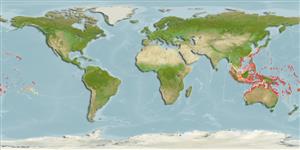
Indo-Pacific: Christmas Island and Rowly Shoals in the eastern Indian Ocean to the Line and Ducie islands, north to south Japan, south to Lord Howe Island.
Größe / Gewicht / Alter
Geschlechtsreife: Lm ? range ? - ? cm
Max length : 27.0 cm TL Männchen/unbestimmt; (Ref. 9710)
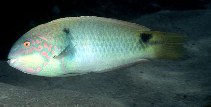
Rückenflossenstacheln (insgesamt) : 9; Rückenflossenweichstrahlen (insgesamt) : 11; Afterflossenstacheln: 3; Afterflossenweichstrahlen: 10 - 11. Light greenish to yellowish on back, white below; scale rims pink to blackish; a black spot is at the upper base of the pectoral fin; another black spot about equal to eye diameter is at the upper base of the caudal peduncle.
Body shape (shape guide): fusiform / normal; Cross section: compressed.
Inhabits sandy areas of reef flats, lagoons, and semi-protected seaward reefs. Juveniles shallow in protected coastal waters; adults to about 30 m depth (Ref. 48636). Feeds on sand and rubble dwelling invertebrates (crustaceans, mollusks, forams, polychaetes, fish eggs, and small fishes). Has the habit of following sand-disturbing fishes such as goatfishes in order to intercept escaping prey. Minimum depth reported taken from Ref. 30874.
Lebenszyklus und Paarungsverhalten
Geschlechtsreife | Fortpflanzung | Ablaichen | Eier | Fruchtbarkeit | Larven
Bi-directional sex change has been confirmed for this species (Ref. 103751). Distinct pairing during breeding (Ref. 205).
Randall, J.E., G.R. Allen and R.C. Steene, 1990. Fishes of the Great Barrier Reef and Coral Sea. University of Hawaii Press, Honolulu, Hawaii. 506 p. (Ref. 2334)
IUCN Rote Liste Status (Ref. 130435: Version 2025-2 (Global))
Bedrohung für Menschen
Harmless
Nutzung durch Menschen
Fischereien: kommerziell; Aquarium: Kommerziell
Tools
Zusatzinformationen
Download XML
Internet Quellen
Schätzungen auf der Grundlage von Modellen
Bevorzugte Temperatur (Ref.
123201): 24.7 - 29.3, mean 28.4 °C (based on 2136 cells).
Phylogenetischer Diversitätsindex (Ref.
82804): PD
50 = 0.5000 [Uniqueness, from 0.5 = low to 2.0 = high].
Bayesian length-weight: a=0.01023 (0.00634 - 0.01651), b=2.99 (2.86 - 3.12), in cm total length, based on LWR estimates for this species & Genus-body shape (Ref.
93245).
Trophische Ebene (Ref.
69278): 3.5 ±0.51 se; based on food items.
Widerstandsfähigkeit (Ref.
120179): mittel, Verdopplung der Population dauert 1,4 - 4,4 Jahre. (Preliminary K or Fecundity.).
Anfälligkeit der Fischerei (Ref.
59153): Low vulnerability (17 of 100).
🛈
Nährstoffe (Ref.
124155): Calcium = 57.9 [35.4, 92.7] mg/100g; Iron = 0.608 [0.360, 1.098] mg/100g; Protein = 18.6 [15.7, 20.7] %; Omega3 = 0.141 [0.095, 0.211] g/100g; Selenium = 25.8 [16.3, 44.2] μg/100g; VitaminA = 119 [38, 421] μg/100g; Zinc = 1.45 [1.04, 2.25] mg/100g (wet weight);