>
Eupercaria/misc (Various families in series Eupercaria) >
Labridae (Wrasses) > Julidinae
Etymology: Halichoeres: Greek, als, alis = salt + Greek, choiros = pig (Ref. 45335).
More on authors: Quoy & Gaimard.
Environnement : milieu / zone climatique / profondeur / gamme de distribution
Écologie
marin récifal; profondeur 2 - 30 m (Ref. 48636), usually 2 - 18 m (Ref. 89972). Tropical; 30°N - 32°S
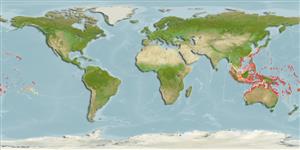
Indo-Pacific: Christmas Island and Rowly Shoals in the eastern Indian Ocean to the Line and Ducie islands, north to south Japan, south to Lord Howe Island.
Taille / Poids / Âge
Maturité: Lm ? range ? - ? cm
Max length : 27.0 cm TL mâle / non sexé; (Ref. 9710)
Description synthétique
Clés d'identification | Morphologie | Morphométrie
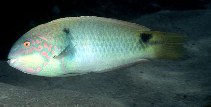
Épines dorsales (Total) : 9; Rayons mous dorsaux (Total) : 11; Épines anales: 3; Rayons mous anaux: 10 - 11. Light greenish to yellowish on back, white below; scale rims pink to blackish; a black spot is at the upper base of the pectoral fin; another black spot about equal to eye diameter is at the upper base of the caudal peduncle.
Body shape (shape guide): fusiform / normal; Cross section: compressed.
Inhabits sandy areas of reef flats, lagoons, and semi-protected seaward reefs. Juveniles shallow in protected coastal waters; adults to about 30 m depth (Ref. 48636). Feeds on sand and rubble dwelling invertebrates (crustaceans, mollusks, forams, polychaetes, fish eggs, and small fishes). Has the habit of following sand-disturbing fishes such as goatfishes in order to intercept escaping prey. Minimum depth reported taken from Ref. 30874.
Cycle de vie et comportement reproducteur
Maturité | Reproduction | Frai | Œufs | Fécondité | Larves
Bi-directional sex change has been confirmed for this species (Ref. 103751). Distinct pairing during breeding (Ref. 205).
Randall, J.E., G.R. Allen and R.C. Steene, 1990. Fishes of the Great Barrier Reef and Coral Sea. University of Hawaii Press, Honolulu, Hawaii. 506 p. (Ref. 2334)
Statut dans la liste rouge de l'IUCN (Ref. 130435: Version 2025-2 (Global))
Menace pour l'homme
Harmless
Utilisations par l'homme
Pêcheries: commercial; Aquarium: Commercial
Outils
Articles particuliers
Télécharger en XML
Sources Internet
Estimations basées sur des modèles
Température préférée (Réf.
123201): 24.7 - 29.3, mean 28.4 °C (based on 2136 cells).
Indice de diversité phylogénétique (Réf.
82804): PD
50 = 0.5000 [Uniqueness, from 0.5 = low to 2.0 = high].
Bayesian length-weight: a=0.01023 (0.00634 - 0.01651), b=2.99 (2.86 - 3.12), in cm total length, based on LWR estimates for this species & Genus-body shape (Ref.
93245).
Niveau trophique (Réf.
69278): 3.5 ±0.51 se; based on food items.
Résilience (Réf.
120179): Milieu, temps minimum de doublement de population : 1,4 à 4,4 années (Preliminary K or Fecundity.).
Vulnérabilité de la pêche (Ref.
59153): Low vulnerability (17 of 100).
🛈
Nutriments (Ref.
124155): Calcium = 57.9 [35.4, 92.7] mg/100g; Iron = 0.608 [0.360, 1.098] mg/100g; Protein = 18.6 [15.7, 20.7] %; Omega3 = 0.141 [0.095, 0.211] g/100g; Selenium = 25.8 [16.3, 44.2] μg/100g; VitaminA = 119 [38, 421] μg/100g; Zinc = 1.45 [1.04, 2.25] mg/100g (wet weight);