Ambiente: milieu / zona climatica / distribuzione batimetrica / gamma di distribuzione
Ecologia
marino; salmastro associati a barriera corallina; distribuzione batimetrica 101 - ? m (Ref. 89707). Subtropical; 15°S - 37°S, 27°E - 51°E (Ref. 5222)
Southeast Atlantic and Western Indian Ocean: known with certainty only from the southeast coast of Africa between Quissico, Mozambique (24°50'S) and Knysna, South Africa (23°E). Reports from Madagascar are dubious.
Lunghezza alla prima maturità / Dimensione / Peso / Età
Maturità: Lm 49.2, range 42 - ? cm
Max length : 87.0 cm TL maschio/sesso non determinato; (Ref. 74502); peso massimo pubblicato: 8.7 kg (Ref. 4787)
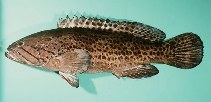
Spine dorsali (totale) : 11; Raggi dorsali molli (totale) : 13 - 15; Spine anali: 3; Raggi anali molli: 8. Distinguished by the following characteristics: head, body and fins brown; body, caudal and dorsal fins with numerous small close-set irregular dark brown spots; 2 dark brown stripes running posteriorly from the eye across operculum, and another continuing from the maxillary groove to the lower edge of the preopercle; body elongate, depth 3.2-3.7 times in SL; greatest body width 1.4-1.8 times in body depth; head length 2.4-2.7 times in SL; angular preopercle, with several enlarged serrae at the angle; upper edge of operculum slightly convex; posterior and anterior nostrils equal; scaly maxilla, reaching to or past vertical at rear edge of eye; 2-3 rows of teeth on midside of lower jaw; rounded caudal fin; ctenoid midlateral-body scales (mostly embedded), with auxiliary scales (Ref. 089707).
Body shape (shape guide): fusiform / normal; Cross section: compressed.
Adults inhabit reefs and rocky bottom to a depth of at least 101 m (Ref. 089707); juveniles are found in tide pools. Feed on fishes and crustaceans. Sexual maturity is attained at 50 to 60 cm. Are diandric protogynous hermaphrodites unlike that of other congeners (Ref. 74502).
Ciclo vitale e comportamento di accoppiamento
Maturità | Riproduzione | Deposizione | Uova | Fecondità | Larve
Diandric protogynous hermaphrodite (Ref. 74502, 103751).
Heemstra, P.C. and J.E. Randall, 1993. FAO Species Catalogue. Vol. 16. Groupers of the world (family Serranidae, subfamily Epinephelinae). An annotated and illustrated catalogue of the grouper, rockcod, hind, coral grouper and lyretail species known to date. Rome: FAO. FAO Fish. Synop. 125(16):382 p. (Ref. 5222)
Stato della Lista Rossa IUCN (Ref. 130435: Version 2025-2 (Global))
Minaccia per l'uomo
Harmless
Usi umani
Pesca: pesca di sussistenza; Pesce da pesca sportiva: si
Strumenti
Rapporti speciali
Scarica XML
Fonti Internet
Stime basate su modelli
Indice di diversità filogenetica (Fonte Biblio.
82804): PD
50 = 0.5000 [Uniqueness, from 0.5 = low to 2.0 = high].
Bayesian length-weight: a=0.01023 (0.00527 - 0.01987), b=3.03 (2.87 - 3.19), in cm total length, based on LWR estimates for this species & Genus-body shape (Ref.
93245).
Livello trofico (Fonte Biblio.
69278): 4.0 ±0.61 se; based on food items.
Resilienza (Fonte Biblio.
120179): Medio, tempo minimo di raddoppiamento della popolazione 1.4 - 4.4 anni (tm=3).
Vulnerabilità della pesca (Ref.
59153): Moderate to high vulnerability (55 of 100).
🛈