Lingkungan: lingkungan / zona iklim / kisaran kedalaman / jangkauan distribusi
Ekologi
laut; payau berasosiasi dengan karang; kisaran kedalaman 101 - ? m (Ref. 89707). Subtropical; 15°S - 37°S, 27°E - 51°E (Ref. 5222)
Southeast Atlantic and Western Indian Ocean: known with certainty only from the southeast coast of Africa between Quissico, Mozambique (24°50'S) and Knysna, South Africa (23°E). Reports from Madagascar are dubious.
Panjang pada saat jatuh tempo pertama / Ukuran / Berat / umur
Kematangan: Lm 49.2, range 42 - ? cm
Max length : 87.0 cm TL jantan/; (Ref. 74502); Berat maksimum terpublikasi: 8.7 kg (Ref. 4787)
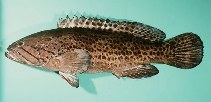
Duri punggung (Keseluruhan (total)) : 11; duri punggung lunak (Keseluruhan (total)) : 13 - 15; Duri dubur: 3; Sirip dubur lunak: 8. Distinguished by the following characteristics: head, body and fins brown; body, caudal and dorsal fins with numerous small close-set irregular dark brown spots; 2 dark brown stripes running posteriorly from the eye across operculum, and another continuing from the maxillary groove to the lower edge of the preopercle; body elongate, depth 3.2-3.7 times in SL; greatest body width 1.4-1.8 times in body depth; head length 2.4-2.7 times in SL; angular preopercle, with several enlarged serrae at the angle; upper edge of operculum slightly convex; posterior and anterior nostrils equal; scaly maxilla, reaching to or past vertical at rear edge of eye; 2-3 rows of teeth on midside of lower jaw; rounded caudal fin; ctenoid midlateral-body scales (mostly embedded), with auxiliary scales (Ref. 089707).
Body shape (shape guide): fusiform / normal; Cross section: compressed.
Adults inhabit reefs and rocky bottom to a depth of at least 101 m (Ref. 089707); juveniles are found in tide pools. Feed on fishes and crustaceans. Sexual maturity is attained at 50 to 60 cm. Are diandric protogynous hermaphrodites unlike that of other congeners (Ref. 74502).
Diandric protogynous hermaphrodite (Ref. 74502, 103751).
Heemstra, P.C. and J.E. Randall, 1993. FAO Species Catalogue. Vol. 16. Groupers of the world (family Serranidae, subfamily Epinephelinae). An annotated and illustrated catalogue of the grouper, rockcod, hind, coral grouper and lyretail species known to date. Rome: FAO. FAO Fish. Synop. 125(16):382 p. (Ref. 5222)
Status IUCN Red List (Ref. 130435: Version 2025-2 (Global))
ancaman kepada manusia
Harmless
penggunaan manusia
Perikanan: perikanan swasembada; Ikan buruan: ya
Alat, peralatan
laporan khas
muat turun XML
Sumber internet
Estimasi berdasarkan model
Indeks keanekaragaman filogenetik (Acuan
82804): PD
50 = 0.5000 [Uniqueness, from 0.5 = low to 2.0 = high].
Bayesian length-weight: a=0.01023 (0.00527 - 0.01987), b=3.03 (2.87 - 3.19), in cm total length, based on LWR estimates for this species & Genus-body shape (Ref.
93245).
Tingkat Trofik (Acuan
69278): 4.0 ±0.61 se; based on food items.
Daya lenting (Acuan
120179): sedang, Waktu penggandaan populasi minimum 1.4 - 4.4 tahun (tm=3).
Kerentanan Penangkapan Ikan (Ref.
59153): Moderate to high vulnerability (55 of 100).
🛈