Elasmobranchii (Haie und Rochen) (sharks and rays) >
Myliobatiformes (Stingrays) >
Dasyatidae (Stingrays) > Urogymninae
Etymology: Himantura: Greek, iman, imantos = thong, strap + Greek, oura = tail (Ref. 45335).
More on author: Gmelin.
Umwelt: Milieu / Klimazone / Tiefenbereich / Verbreitungsgebiet
Ökologie
seewasser; brackwasser demersal; amphidrom (Ref. 51243); tiefenbereich 20 - 50 m (Ref. 28016). Subtropical; 23°C - 26°C (Ref. 12468); 38°N - 37°S, 34°E - 149°W
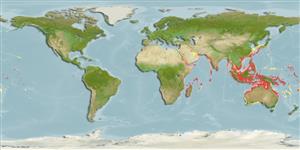
Indo-Pacific: Persian Gulf (Ref.80050); Red Sea (and eastern Mediterranean via Suez Canal) to southern Africa and French Polynesia, north to Taiwan, south to Australia. Also in the Arafura Sea (Ref. 9819). Collected from the estuary of the River Ganges (Ref. 33178). This name has been used for a number of similar spotted species (Ref. 6871). Probably a species complex (Ref. 35766). Its identity has been confused in many publications and Micronesian specimens should be re-examined (Ref. 37816).
Länge bei der ersten Reifung / Größe / Gewicht / Alter
Geschlechtsreife: Lm 83.0, range 82 - 84 cm
Max length : 200 cm WD Männchen/unbestimmt; (Ref. 3263); common length : 45.0 cm TL Männchen/unbestimmt; (Ref. 5450); max. veröff. Gewicht: 150.0 kg (Ref. 124786)
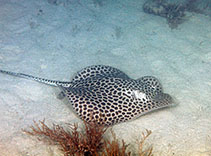
Rückenflossenstacheln (insgesamt) : 0; Afterflossenstacheln: 0. Huge stingray with conspicuous dark spots on a light brown disc; spots well-spaced in young but crowded to form reticulated pattern in adult; white ventrally; tail marked with bands of black and white; snout sharply pointed; disc with narrowly rounded outer corners, and tail long, slender and nearly three times body length when intact, with no caudal finfolds; disc without thorns but with band of flat denticles along midback (in adults); usually 1 medium-sized sting on tail (Ref. 5578).
Body shape (shape guide): other.
Common off sandy beaches and in shallow estuaries and lagoons; also found in sandy areas of coral reefs (Ref. 9710). Also offshore down to 50 m depth (Ref. 5578). May enter fresh water (Ref. 5578). Feeds on small fishes, bivalves, crabs, shrimps, worms (Ref. 3263) and jellyfishes (Ref. 37816). Ovoviviparous (Ref. 50449). Common catch of the demersal tangle net, bottom trawl, longline and beach seine fisheries (Ref.58048). Popular angling fish (Ref. 3263). Not esteemed as a food fish (Ref. 3263). Used in Chinese medicine (Ref. 12166). Tail is used as It is parasitised by the monogeneans Dendromonocotyle colorni and Dendromonocotyle ukuthena on the dorsal skin surface (Ref. 124058).
Exhibit ovoviparity (aplacental viviparity), with embryos feeding initially on yolk, then receiving additional nourishment from the mother by indirect absorption of uterine fluid enriched with mucus, fat or protein through specialised structures (Ref. 50449). Distinct pairing with embrace (Ref. 205). Distinct pairing with embrace (Ref. 205). Bears 3 to 5 young in the summer (Ref. 5578). Size at birth about 21 (Ref.58048) - 28 cm WD (Ref. 6871).
Fricke, R., 1999. Fishes of the Mascarene Islands (Réunion, Mauritius, Rodriguez): an annotated checklist, with descriptions of new species. Koeltz Scientific Books, Koenigstein, Theses Zoologicae, Vol. 31:759 p. (Ref. 33390)
IUCN Rote Liste Status (Ref. 130435: Version 2025-2 (Global))
Nutzung durch Menschen
Fischereien: weniger kommerziell; Sportfisch: ja; Aquarium: Kommerziell
Tools
Zusatzinformationen
Download XML
Internet Quellen
Schätzungen auf der Grundlage von Modellen
Bevorzugte Temperatur (Ref.
123201): 24.2 - 28.6, mean 27.8 °C (based on 334 cells).
Phylogenetischer Diversitätsindex (Ref.
82804): PD
50 = 0.5002 [Uniqueness, from 0.5 = low to 2.0 = high].
Bayesian length-weight: a=0.02138 (0.01168 - 0.03914), b=3.14 (2.96 - 3.32), in cm total length, based on LWR estimates for this species & (Sub)family-body (Ref.
93245).
Trophische Ebene (Ref.
69278): 3.6 ±0.6 se; based on diet studies.
Widerstandsfähigkeit (Ref.
120179): sehr niedrig, Verdopplung der Population dauert mehr als 14 Jahre. (Fec=3-5).
Anfälligkeit der Fischerei (Ref.
59153): Very high vulnerability (90 of 100).
🛈
Nährstoffe (Ref.
124155): Calcium = 3.06 [0.35, 48.42] mg/100g; Iron = 0.343 [0.028, 3.859] mg/100g; Protein = 22.3 [19.6, 25.0] %; Omega3 = 0.113 [0.036, 0.335] g/100g; Selenium = 15.7 [2.7, 86.6] μg/100g; VitaminA = 10.9 [0.9, 124.7] μg/100g; Zinc = 0.504 [0.035, 5.570] mg/100g (wet weight);