>
Eupercaria/misc (Various families in series Eupercaria) >
Labridae (Wrasses) > Hypsigenyinae
Etymology: Bodianus: Bodianus after Bodiano or Pudiano, from the Portuguese pudor, meaning modesty (Jordan & Evermann, 1896); axillaris: Name from the Latin noun axilla for arm pit, apparently referring to the prominent black spot in the axilla of the pectoral fin (Ref. 75973).
More on author: Bennett.
Entorno: milieu / zona climática / rango de profundidad / gama de distribución
Ecología
marino asociado a arrecife; rango de profundidad 2 - 100 m (Ref. 9823), usually 2 - 40 m (Ref. 27115). Tropical; 24°C - 27°C (Ref. 27115); 32°N - 32°S
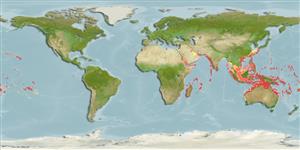
Indo-Pacific: Red Sea to South Africa (Ref. 35918), east to the Marshall, Marquesan and Tuamoto islands, north to Japan (Ref. 559).
Tamaño / Peso / Edad
Madurez: Lm ? range ? - ? cm
Max length : 20.0 cm SL macho / no sexado; (Ref. 9823)
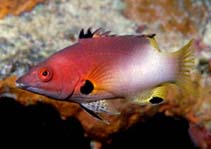
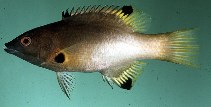
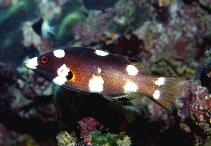
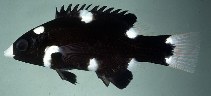
Espinas dorsales (total) : 12; Radios blandos dorsales (total) : 9 - 10; Espinas anales: 3; Radios blandos anales: 12 - 13. Juveniles and females easily recognized by the generally black body with large white spots; males have large black spots on the soft parts of the dorsal and anal fins (Ref. 48636). Juveniles resemble the juveniles of B. mesothorax but have white rather than yellow spots. Undergoes a dramatic color change with growth.
Body shape (shape guide): fusiform / normal; Cross section: compressed.
Adults inhabit clear lagoon and seaward reefs (Ref. 1602); common in clear shallow waters at 1-8 m; large individuals occasionally at greater depths below 27 m (Ref. 75973). Juveniles occur solitary in caves or under ledges and act as cleaners by picking at bodies of other fishes (adults occasionally do this) (Ref. 1602); occurring regularly at depths of 14-26 m (Ref. 75973). Feed mainly on benthic, hard-shelled, invertebrates such as mollusks and crustaceans (Ref. 9823). Oviparous, distinct pairing during breeding (Ref. 205). Not commonly marketed. Occasionally seen in the aquarium trade.
Ciclo vital y comportamiento de apareamiento
Madurez | Reproducción | Puesta | Huevos | Fecundidad | Larva
Oviparous, distinct pairing during breeding (Ref. 205).
Westneat, M.W., 2001. Labridae. Wrasses, hogfishes, razorfishes, corises, tuskfishes. p. 3381-3467. In K.E. Carpenter and V. Niem (eds.) FAO species identification guide for fishery purposes. The living marine resources of the Western Central Pacific. Vol. 6. Bony fishes part 4 (Labridae to Latimeriidae), estuarine crocodiles. FAO, Rome. (Ref. 9823)
Situación en la Lista Roja de la UICN (Ref. 130435: Version 2025-2 (Global))
Amenaza para el ser humano
Harmless
Usos humanos
Pesquerías: escaso valor comercial; Acuario: Comercial; carnada: occasionally
Herramientas
Informes especiales
Descargar XML
Fuentes de Internet
Estimaciones basadas en modelos
Temperatura preferida (Referencia
123201): 24.4 - 28.9, mean 27.5 °C (based on 1326 cells).
Índice de diversidad filogenética (Referencia
82804): PD
50 = 0.5000 [Uniqueness, from 0.5 = low to 2.0 = high].
Bayesian length-weight: a=0.01047 (0.00493 - 0.02225), b=3.08 (2.90 - 3.26), in cm total length, based on LWR estimates for this Genus-body shape (Ref.
93245).
Nivel trófico (Referencia
69278): 3.4 ±0.45 se; based on food items.
Resiliencia (Referencia
120179): Medio, población duplicada en un tiempo mínimo de 1.4-4.4 años (Preliminary K or Fecundity.).
Vulnerabilidad pesquera (Ref.
59153): Low vulnerability (14 of 100).
🛈
Nutrientes (Ref.
124155): Calcium = 64.3 [38.8, 105.2] mg/100g; Iron = 0.638 [0.378, 1.154] mg/100g; Protein = 18.4 [15.5, 20.5] %; Omega3 = 0.166 [0.109, 0.252] g/100g; Selenium = 31.1 [19.0, 52.4] μg/100g; VitaminA = 136 [42, 504] μg/100g; Zinc = 1.54 [1.09, 2.42] mg/100g (wet weight);