>
Eupercaria/misc (Various families in series Eupercaria) >
Labridae (Wrasses) > Hypsigenyinae
Etymology: Bodianus: Bodianus after Bodiano or Pudiano, from the Portuguese pudor, meaning modesty (Jordan & Evermann, 1896); axillaris: Name from the Latin noun axilla for arm pit, apparently referring to the prominent black spot in the axilla of the pectoral fin (Ref. 75973).
More on author: Bennett.
Ambiente: milieu / zona climatica / distribuzione batimetrica / gamma di distribuzione
Ecologia
marino associati a barriera corallina; distribuzione batimetrica 2 - 100 m (Ref. 9823), usually 2 - 40 m (Ref. 27115). Tropical; 24°C - 27°C (Ref. 27115); 32°N - 32°S
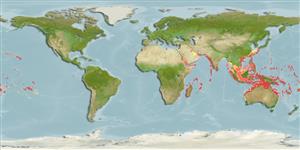
Indo-Pacific: Red Sea to South Africa (Ref. 35918), east to the Marshall, Marquesan and Tuamoto islands, north to Japan (Ref. 559).
Dimensione / Peso / Età
Maturità: Lm ? range ? - ? cm
Max length : 20.0 cm SL maschio/sesso non determinato; (Ref. 9823)
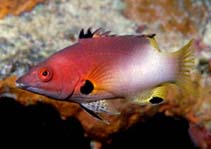
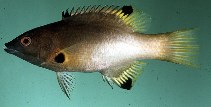
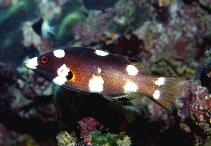
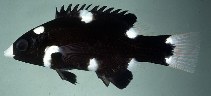
Spine dorsali (totale) : 12; Raggi dorsali molli (totale) : 9 - 10; Spine anali: 3; Raggi anali molli: 12 - 13. Juveniles and females easily recognized by the generally black body with large white spots; males have large black spots on the soft parts of the dorsal and anal fins (Ref. 48636). Juveniles resemble the juveniles of B. mesothorax but have white rather than yellow spots. Undergoes a dramatic color change with growth.
Body shape (shape guide): fusiform / normal; Cross section: compressed.
Adults inhabit clear lagoon and seaward reefs (Ref. 1602); common in clear shallow waters at 1-8 m; large individuals occasionally at greater depths below 27 m (Ref. 75973). Juveniles occur solitary in caves or under ledges and act as cleaners by picking at bodies of other fishes (adults occasionally do this) (Ref. 1602); occurring regularly at depths of 14-26 m (Ref. 75973). Feed mainly on benthic, hard-shelled, invertebrates such as mollusks and crustaceans (Ref. 9823). Oviparous, distinct pairing during breeding (Ref. 205). Not commonly marketed. Occasionally seen in the aquarium trade.
Ciclo vitale e comportamento di accoppiamento
Maturità | Riproduzione | Deposizione | Uova | Fecondità | Larve
Oviparous, distinct pairing during breeding (Ref. 205).
Westneat, M.W., 2001. Labridae. Wrasses, hogfishes, razorfishes, corises, tuskfishes. p. 3381-3467. In K.E. Carpenter and V. Niem (eds.) FAO species identification guide for fishery purposes. The living marine resources of the Western Central Pacific. Vol. 6. Bony fishes part 4 (Labridae to Latimeriidae), estuarine crocodiles. FAO, Rome. (Ref. 9823)
Stato della Lista Rossa IUCN (Ref. 130435: Version 2025-2 (Global))
Minaccia per l'uomo
Harmless
Usi umani
Pesca: scarso interesse commerciale; Acquario: Commerciale; esca: occasionally
Strumenti
Rapporti speciali
Scarica XML
Fonti Internet
Stime basate su modelli
Temperatura preferita (Fonte Biblio.
123201): 24.4 - 28.9, mean 27.5 °C (based on 1326 cells).
Indice di diversità filogenetica (Fonte Biblio.
82804): PD
50 = 0.5000 [Uniqueness, from 0.5 = low to 2.0 = high].
Bayesian length-weight: a=0.01047 (0.00493 - 0.02225), b=3.08 (2.90 - 3.26), in cm total length, based on LWR estimates for this Genus-body shape (Ref.
93245).
Livello trofico (Fonte Biblio.
69278): 3.4 ±0.45 se; based on food items.
Resilienza (Fonte Biblio.
120179): Medio, tempo minimo di raddoppiamento della popolazione 1.4 - 4.4 anni (Preliminary K or Fecundity.).
Vulnerabilità della pesca (Ref.
59153): Low vulnerability (14 of 100).
🛈
Nutrienti (Ref.
124155): Calcium = 64.3 [38.8, 105.2] mg/100g; Iron = 0.638 [0.378, 1.154] mg/100g; Protein = 18.4 [15.5, 20.5] %; Omega3 = 0.166 [0.109, 0.252] g/100g; Selenium = 31.1 [19.0, 52.4] μg/100g; VitaminA = 136 [42, 504] μg/100g; Zinc = 1.54 [1.09, 2.42] mg/100g (wet weight);