>
Syngnathiformes (Pipefishes and seahorses) >
Fistulariidae (Cornetfishes)
Etymology: Fistularia: Latin, fistula, -ae = pipe, flute (Ref. 45335).
Eponymy: Dr Philibert Commerson (1727–1773) was known as ‘doctor, botanist and naturalist of the King’. [...] (Ref. 128868), visit book page.
More on author: Rüppell.
Taxonomic Remarks
Often misidentified as Fistularia petimba Lacepède, 1803, a reddish or brownish-orange deep-water species with bony plates along dorsal midline.
Ambiente: milieu / zona climatica / distribuzione batimetrica / gamma di distribuzione
Ecologia
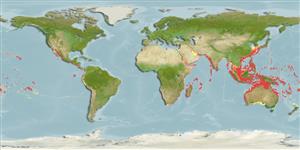
marino associati a barriera corallina; distribuzione batimetrica 0 - 132 m (Ref. 58302). Tropical; 37°N - 38°S, 20°E - 70°W
Indo-Pacific: East Africa and Red Sea and to Rapa and Easter Island, north to southern Japan, south to Australia and New Zealand (Ref. 5755). Eastern Central Pacific: Mexico to Panama, including offshore islands (Ref. 9301). Lessepsian migrant to the Mediterranean; first reported in Ref. 36327, and from several countries as of late year 2010.
Lunghezza alla prima maturità / Dimensione / Peso / Età
Maturità: Lm 65.0 range ? - ? cm
Max length : 160 cm TL maschio/sesso non determinato; (Ref. 9301); common length : 100.0 cm TL maschio/sesso non determinato; (Ref. 9301)
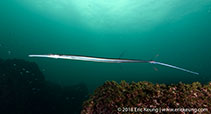
Spine dorsali (totale) : 0; Raggi dorsali molli (totale) : 14 - 17; Spine anali: 0; Raggi anali molli: 14 - 16; Vertebre: 83 - 86. Vertically flattened rather than laterally compressed body. Long whiplike tail filament. Color is green dorsally, grading to silvery white ventrally, with two blue stripes or rows of blue spots on the back. Dorsal and anal fin orange becoming transparent at base. Caudal filament white. Broadly banded at night (Ref. 48635). First four vertebrae fused (Ref. 9826). Branchiostegal rays: 5 (Ref. 36710).
Body shape (shape guide): elongated; Cross section: flattened.
Adults inhabit reef habitats to a depth of at least 128 m, except in heavy surge areas. Also found in sandy bottoms adjacent to reef areas (Ref. 36710), either solitary or in schools (Ref. 9710). Benthopelagic (Ref. 58302). Feed on small fishes, shrimps (Ref. 36327, 36710) and squids (Ref. 37816). Probably marketed fresh, salted or dried or smoked but more often reduced to fish meal (Ref. 9301).
Myers, R.F., 1991. Micronesian reef fishes. Second Ed. Coral Graphics, Barrigada, Guam. 298 p. (Ref. 1602)
Stato della Lista Rossa IUCN (Ref. 130435: Version 2025-2 (Global))
Minaccia per l'uomo
Reports of ciguatera poisoning (Ref. 130160)
Usi umani
Pesca: scarso interesse commerciale; Acquario: Commerciale
Strumenti
Rapporti speciali
Scarica XML
Fonti Internet
Stime basate su modelli
Temperatura preferita (Fonte Biblio.
123201): 22 - 28.9, mean 27.5 °C (based on 1674 cells).
Indice di diversità filogenetica (Fonte Biblio.
82804): PD
50 = 0.6250 [Uniqueness, from 0.5 = low to 2.0 = high].
Bayesian length-weight: a=0.00098 (0.00071 - 0.00134), b=3.03 (2.94 - 3.12), in cm total length, based on LWR estimates for this species (Ref.
93245).
Livello trofico (Fonte Biblio.
69278): 4.3 ±0.7 se; based on diet studies.
Generation time: 2.2 ( na - na) years. Estimated as median ln(3)/K based on 1
growth studies.
Resilienza (Fonte Biblio.
120179): Alto, tempo minimo di raddoppiamento della popolazione meno di 15 mesi (K=0.49;).
Vulnerabilità della pesca (Ref.
59153): Moderate vulnerability (42 of 100).
🛈
Nutrienti (Ref.
124155): Calcium = 32.7 [16.6, 62.5] mg/100g; Iron = 0.71 [0.38, 1.40] mg/100g; Protein = 18.7 [17.4, 19.9] %; Omega3 = 0.101 [0.050, 0.213] g/100g; Selenium = 93.7 [47.8, 203.3] μg/100g; VitaminA = 23.6 [8.1, 70.0] μg/100g; Zinc = 0.712 [0.467, 1.100] mg/100g (wet weight);