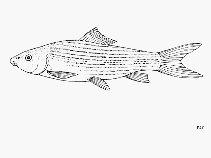
>
Cypriniformes (Carps) >
Cyprinidae (Minnows or carps) > Labeoninae
Etymology: Labeo: Latin, labeo = one who has large lips (Ref. 45335); mesops: From the Greek word mesos meaning middle or half and opsis meaning sight; name refers to the state of the type material which was only half of the skin (Ref. 26190).
More on author: Günther.
Entorno: milieu / zona climática / rango de profundidad / gama de distribución
Ecología
; agua dulce bentopelágico; potamodromo (Ref. 51243). Tropical
Africa: present in Lake Malawi basin (Ref. 1878, 52161, 55909, 96560), Juba system (1440) and Ruvuma River (Ref. 1440, 97286). Status Tana River population is uncertain (Ref. 52331). Reports from the Lufira River, Upper Congo River basin (Ref. 1440, 26190), are misidentifications of Labeo rosae (Ref. 96560).
Longitud en la primera madurez / Tamaño / Peso / Edad
Madurez: Lm 33.9 range ? - ? cm
Max length : 39.0 cm TL macho / no sexado; (Ref. 2801)
Descripción breve
Claves de identificación | Morfología | Morfometría
Espinas dorsales (total) : 3; Radios blandos dorsales (total) : 10 - 12; Espinas anales: 3; Radios blandos anales: 5; Vértebra: 34.
Body shape (shape guide): fusiform / normal; Cross section: oval.
Found in shallow water over sandy bottoms (Ref. 5595, 52161). Is a mud-feeder (Ref. 52161), feeds from the biocover and sediment on the sand (Ref. 5595). Also caught using weirs and baskets; formerly very abundant in Malawi, but now rare except where rivers drain undisturbed soil; possible that silt prevents development of eggs (Ref. 4967). Indications that it may leave the lake and run up rivers to spawn (Ref. 52161).
Ciclo vital y comportamiento de apareamiento
Madurez | Reproducción | Puesta | Huevos | Fecundidad | Larva
Spawns in small, muddy wet season rivers leading to swampy dambos (Ref. 2781). Holds its spawn until the rivers flood.
Tshibwabwa, S.M., 1997. Systématique des espèces africaines du genre Labeo (Teleostei, Cyprinidae) dans les régions ichtyogéographiques de Basse-Guinée et du Congo. I. Presses Universitaires de Namur, Namur, Belgique. 302 p. (Ref. 26190)
Situación en la Lista Roja de la UICN (Ref. 130435: Version 2025-2 (Global))
Amenaza para el ser humano
Harmless
Usos humanos
Pesquerías: sin interés; Acuicultura: experimental; Acuario: Comercial
Herramientas
Informes especiales
Descargar XML
Fuentes de Internet
Estimaciones basadas en modelos
Índice de diversidad filogenética (Referencia
82804): PD
50 = 0.5000 [Uniqueness, from 0.5 = low to 2.0 = high].
Bayesian length-weight: a=0.00912 (0.00420 - 0.01982), b=3.05 (2.88 - 3.22), in cm total length, based on LWR estimates for this Genus-body shape (Ref.
93245).
Nivel trófico (Referencia
69278): 2.0 ±0.00 se; based on food items.
Resiliencia (Referencia
120179): Medio, población duplicada en un tiempo mínimo de 1.4-4.4 años (Preliminary K or Fecundity.).
Vulnerabilidad pesquera (Ref.
59153): Low to moderate vulnerability (29 of 100).
🛈
Nutrientes (Ref.
124155): Calcium = 187 [52, 326] mg/100g; Iron = 0.926 [0.548, 1.671] mg/100g; Protein = 16.3 [15.4, 17.2] %; Omega3 = 0.418 [0.163, 1.162] g/100g; Selenium = 305 [114, 870] μg/100g; VitaminA = 20.6 [7.7, 57.4] μg/100g; Zinc = 1.64 [0.88, 3.32] mg/100g (wet weight);