>
Carangiformes (Jacks) >
Carangidae (Jacks and pompanos) > Caranginae
Etymology: Trachurus: Greek, trachys, -eia, -ys = rough + Greek, oura = tail (Ref. 45335).
More on author: Castelnau.
Environnement : milieu / zone climatique / profondeur / gamme de distribution
Écologie
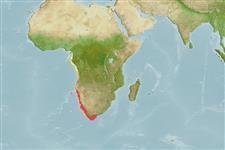
marin pelagic-neritic; profondeur 0 - 500 m (Ref. 54925), usually 100 - 300 m (Ref. 54925). Subtropical; 7°N - 37°S, 4°E - 24°E (Ref. 54925)
Eastern Atlantic: Gulf of Guinea to South Africa. Bianchi et. al. 1993 notes 'Smith-Vaniz (1992, pers. comm.) does not believe that Trachurus capensis is a valid species but admits that an adequate series of this species along the coast of Africa are not available'.
Longueur à la première maturité / Taille / Poids / Âge
Maturité: Lm 32.5, range 20 - 33 cm
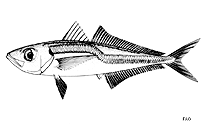
Max length : 60.0 cm FL mâle / non sexé; (Ref. 3166); common length : 30.0 cm FL mâle / non sexé; (Ref. 3166)
Description synthétique
Clés d'identification | Morphologie | Morphométrie
Adults are found mainly over the continental shelf, often over sand bottoms (Ref. 27121). Shoals rise to feed in surface waters at night and found close to the bottom during the day (Ref. 27121). Juveniles feed mainly on copepods while adults prey on fish and a wide range of invertebrates (Ref. 27121).
Cycle de vie et comportement reproducteur
Maturité | Reproduction | Frai | Œufs | Fécondité | Larves
Smith-Vaniz, W.F., J.-C. Quéro and M. Desoutter, 1990. Carangidae. p. 729-755. In J.C. Quero, J.C. Hureau, C. Karrer, A. Post and L. Saldanha (eds.) Check-list of the fishes of the eastern tropical Atlantic (CLOFETA). JNICT, Lisbon; SEI, Paris; and UNESCO, Paris. Vol. 2. (Ref. 7097)
Statut dans la liste rouge de l'IUCN (Ref. 130435: Version 2025-2 (Global))
Menace pour l'homme
Harmless
Utilisations par l'homme
Pêcheries: hautement commercial
Outils
Articles particuliers
Télécharger en XML
Sources Internet
Estimations basées sur des modèles
Température préférée (Réf.
123201): 9.2 - 15.2, mean 11.2 °C (based on 76 cells).
Indice de diversité phylogénétique (Réf.
82804): PD
50 = 0.5001 [Uniqueness, from 0.5 = low to 2.0 = high].
Bayesian length-weight: a=0.01000 (0.00614 - 0.01628), b=2.95 (2.81 - 3.09), in cm total length, based on LWR estimates for this species & Genus-body shape (Ref.
93245).
Niveau trophique (Réf.
69278): 3.5 ±0.50 se; based on food items.
Generation time: 7.8 (2.6 - 10.0) years. Estimated as median ln(3)/K based on 10
growth studies.
Résilience (Réf.
120179): Milieu, temps minimum de doublement de population : 1,4 à 4,4 années (K=0.11-0.42; tm=2).
Prior r = 0.35, 95% CL = 0.23 - 0.52, Based on 2 full stock assessments.
Vulnérabilité de la pêche (Ref.
59153): High vulnerability (60 of 100).
🛈
Vulnérabilité climatique (Ref.
125649): Low to moderate vulnerability (30 of 100).
🛈
Nutriments (Ref.
124155): Calcium = 210 [144, 303] mg/100g; Iron = 3.78 [2.52, 5.83] mg/100g; Protein = 19.3 [18.7, 19.9] %; Omega3 = 0.328 [0.240, 0.450] g/100g; Selenium = 27.7 [20.3, 38.9] μg/100g; VitaminA = 15 [4, 64] μg/100g; Zinc = 1.86 [1.49, 2.46] mg/100g (wet weight);