>
Carangiformes (Jacks) >
Carangidae (Jacks and pompanos) > Caranginae
Etymology: Trachurus: Greek, trachys, -eia, -ys = rough + Greek, oura = tail (Ref. 45335).
More on author: Castelnau.
Milieu: milieu / Klimaatzone / Diepte / verspreidingsgebied
Ecologie
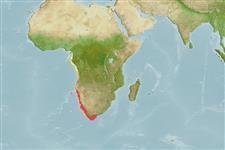
marien pelagic-neritic; diepte 0 - 500 m (Ref. 54925), usually 100 - 300 m (Ref. 54925). Subtropical; 7°N - 37°S, 4°E - 24°E (Ref. 54925)
Eastern Atlantic: Gulf of Guinea to South Africa. Bianchi et. al. 1993 notes 'Smith-Vaniz (1992, pers. comm.) does not believe that Trachurus capensis is a valid species but admits that an adequate series of this species along the coast of Africa are not available'.
Lengte bij maturiteit / Grootte / Gewicht / Leeftijd
Maturiteit: Lm 32.5, range 20 - 33 cm
Max length : 60.0 cm FL mannelijk / geslacht onbekend; (Ref. 3166); common length : 30.0 cm FL mannelijk / geslacht onbekend; (Ref. 3166)
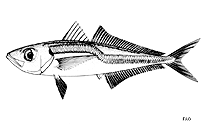
Korte beschrijving
Determinatiesleutels | Morfologie | Morfometrie
Adults are found mainly over the continental shelf, often over sand bottoms (Ref. 27121). Shoals rise to feed in surface waters at night and found close to the bottom during the day (Ref. 27121). Juveniles feed mainly on copepods while adults prey on fish and a wide range of invertebrates (Ref. 27121).
Smith-Vaniz, W.F., J.-C. Quéro and M. Desoutter, 1990. Carangidae. p. 729-755. In J.C. Quero, J.C. Hureau, C. Karrer, A. Post and L. Saldanha (eds.) Check-list of the fishes of the eastern tropical Atlantic (CLOFETA). JNICT, Lisbon; SEI, Paris; and UNESCO, Paris. Vol. 2. (Ref. 7097)
Status op de Rode Lijst van het IUCN (Ref. 130435: Version 2025-2 (Global))
Gevaar voor de mens
Harmless
Gebruik door de mens
Visserij: van groot commercieel belang
Tools
Speciale rapporten
Download XML
Internetbronnen
Schattingen op basis van modellen
Gewenste temperatuur (Ref.
123201): 9.2 - 15.2, mean 11.2 °C (based on 76 cells).
Fylogenetische diversiteitsindex (Ref.
82804): PD
50 = 0.5001 [Uniqueness, from 0.5 = low to 2.0 = high].
Bayesian length-weight: a=0.01000 (0.00614 - 0.01628), b=2.95 (2.81 - 3.09), in cm total length, based on LWR estimates for this species & Genus-body shape (Ref.
93245).
Trofisch niveau (Ref.
69278): 3.5 ±0.50 se; based on food items.
Generation time: 7.8 (2.6 - 10.0) years. Estimated as median ln(3)/K based on 10
growth studies.
Weerstandsvermogen (Ref.
120179): Gemiddeld, minimale populatieverdubbelingstijd 1,4-4,4 jaar (K=0.11-0.42; tm=2).
Prior r = 0.35, 95% CL = 0.23 - 0.52, Based on 2 full stock assessments.
Kwetsbaarheid van de visserij (Ref.
59153): High vulnerability (60 of 100).
🛈
Kwetsbaarheid voor het klimaat (Ref.
125649): Low to moderate vulnerability (30 of 100).
🛈
Voedingsstoffen (Ref.
124155): Calcium = 210 [144, 303] mg/100g; Iron = 3.78 [2.52, 5.83] mg/100g; Protein = 19.3 [18.7, 19.9] %; Omega3 = 0.328 [0.240, 0.450] g/100g; Selenium = 27.7 [20.3, 38.9] μg/100g; VitaminA = 15 [4, 64] μg/100g; Zinc = 1.86 [1.49, 2.46] mg/100g (wet weight);